Reading RPLS is free for the whole profession. Members post, reply, and get the members-only rooms.

Notifications
Clear all
Strictly Surveying
22
Posts
5
Users
0
Reactions
1,229
Views

Topic starter
Translate
▼
English
Spanish
French
German
Italian
Portuguese
Russian
Chinese
Japanese
Korean
Arabic
Hindi
Dutch
Polish
Turkish
Vietnamese
Thai
Swedish
Danish
Finnish
Norwegian
Czech
Hungarian
Romanian
Greek
Hebrew
Indonesian
Malay
Ukrainian
Bulgarian
Croatian
Slovak
Slovenian
Serbian
Lithuanian
Latvian
Estonian
I was looking through a copy of a field book kept in 1887 by a Texas surveyor named J.L. Long in the course of an extensive amount of resurvey work he carried out near the edge of Oklahoma. Mr. Long and others were set to the task of actually figuring out where hundreds of nominally mile-square sections had been located across an expanse of prairie in 1867, but mostly on paper. By 1887, there was a pressing need to actually determine where the sections were, roughly half of which had already been patented and the other half the alternate sections that the State of Texas hoped to sell to fund schools.
There among the notes of Mr. Long's hundreds of miles of traverse, two miles to a page, was something that that I don't recall ever having seen before, but which may represent a common practice of the day. The clue is this handwritten table:
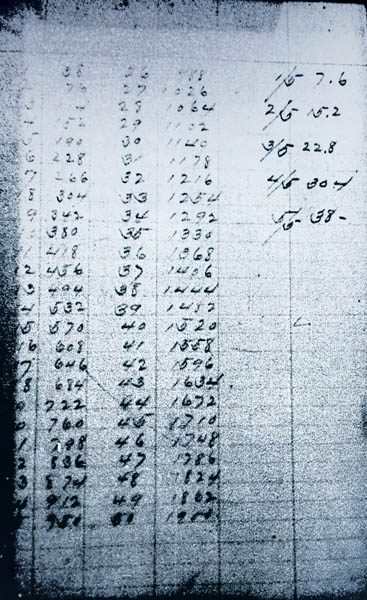
The top rows read:
[PRE]1 38 26 988
2 76 27 1026
3 114 28 1064
4 152 29 1102[/PRE]
What do you suppose one might reasonably deduce from the above table?
Posted : May 11, 2017 5:22 pm

Translate
▼
English
Spanish
French
German
Italian
Portuguese
Russian
Chinese
Japanese
Korean
Arabic
Hindi
Dutch
Polish
Turkish
Vietnamese
Thai
Swedish
Danish
Finnish
Norwegian
Czech
Hungarian
Romanian
Greek
Hebrew
Indonesian
Malay
Ukrainian
Bulgarian
Croatian
Slovak
Slovenian
Serbian
Lithuanian
Latvian
Estonian
He wanted a quick reference for measuring in varas using a 100' chain?
Posted : May 11, 2017 5:47 pm
Topic starter
Translate
▼
English
Spanish
French
German
Italian
Portuguese
Russian
Chinese
Japanese
Korean
Arabic
Hindi
Dutch
Polish
Turkish
Vietnamese
Thai
Swedish
Danish
Finnish
Norwegian
Czech
Hungarian
Romanian
Greek
Hebrew
Indonesian
Malay
Ukrainian
Bulgarian
Croatian
Slovak
Slovenian
Serbian
Lithuanian
Latvian
Estonian
flyin solo, post: 427908, member: 8089 wrote: He wanted a quick reference for measuring in varas using a 100' chain?
Except 36 varas = 100 ft. 38 varas = 105.56 ft., So his chain was 105.56 ft. long.
Posted : May 11, 2017 5:49 pm
Translate
▼
English
Spanish
French
German
Italian
Portuguese
Russian
Chinese
Japanese
Korean
Arabic
Hindi
Dutch
Polish
Turkish
Vietnamese
Thai
Swedish
Danish
Finnish
Norwegian
Czech
Hungarian
Romanian
Greek
Hebrew
Indonesian
Malay
Ukrainian
Bulgarian
Croatian
Slovak
Slovenian
Serbian
Lithuanian
Latvian
Estonian
Right. Best I could come up with in lightning round mode.
5280/1900= 2.778
So a 1/50th mile chain?
Posted : May 11, 2017 5:50 pm

Translate
▼
English
Spanish
French
German
Italian
Portuguese
Russian
Chinese
Japanese
Korean
Arabic
Hindi
Dutch
Polish
Turkish
Vietnamese
Thai
Swedish
Danish
Finnish
Norwegian
Czech
Hungarian
Romanian
Greek
Hebrew
Indonesian
Malay
Ukrainian
Bulgarian
Croatian
Slovak
Slovenian
Serbian
Lithuanian
Latvian
Estonian
We can rule out the Fibonacci numbers...
Posted : May 11, 2017 5:51 pm
Topic starter
Translate
▼
English
Spanish
French
German
Italian
Portuguese
Russian
Chinese
Japanese
Korean
Arabic
Hindi
Dutch
Polish
Turkish
Vietnamese
Thai
Swedish
Danish
Finnish
Norwegian
Czech
Hungarian
Romanian
Greek
Hebrew
Indonesian
Malay
Ukrainian
Bulgarian
Croatian
Slovak
Slovenian
Serbian
Lithuanian
Latvian
Estonian
flyin solo, post: 427910, member: 8089 wrote: So a 1/50th mile chain?
Yes, that's what the table describes. Next question is exactly what sort of a thing that chain really was.
He was surveying on the North Texas prairie, but the chaining notes in his field book indicate 200 vara "outs".
Posted : May 11, 2017 6:14 pm
Topic starter
Translate
▼
English
Spanish
French
German
Italian
Portuguese
Russian
Chinese
Japanese
Korean
Arabic
Hindi
Dutch
Polish
Turkish
Vietnamese
Thai
Swedish
Danish
Finnish
Norwegian
Czech
Hungarian
Romanian
Greek
Hebrew
Indonesian
Malay
Ukrainian
Bulgarian
Croatian
Slovak
Slovenian
Serbian
Lithuanian
Latvian
Estonian
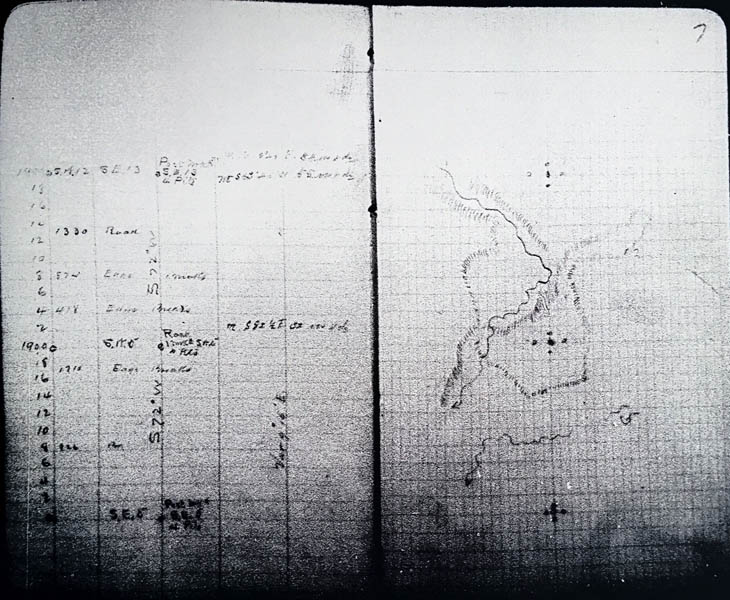
Here's a typical page from that 1887 field book as an example. Note that the fieldbook reads from bottom to top:
Posted : May 11, 2017 7:00 pm
Topic starter
Translate
▼
English
Spanish
French
German
Italian
Portuguese
Russian
Chinese
Japanese
Korean
Arabic
Hindi
Dutch
Polish
Turkish
Vietnamese
Thai
Swedish
Danish
Finnish
Norwegian
Czech
Hungarian
Romanian
Greek
Hebrew
Indonesian
Malay
Ukrainian
Bulgarian
Croatian
Slovak
Slovenian
Serbian
Lithuanian
Latvian
Estonian
But here is some of the arithmetic that appears on the book's endpaper:
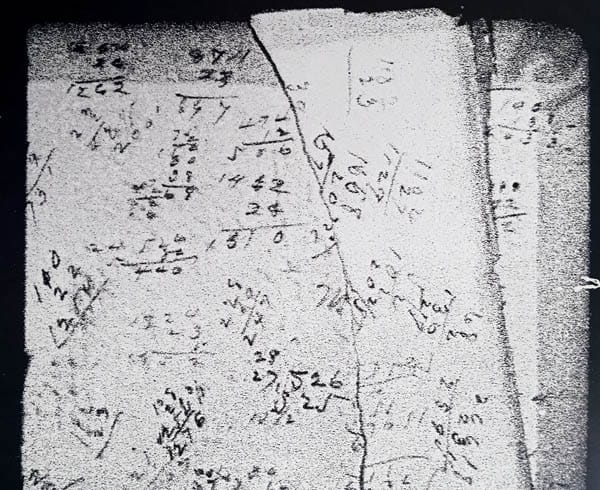
Those addition problems include:
[PRE]874 1102 494 228
23 27 12 19
---- ---- ---- ----
897 1129 596 247
[/PRE]
In other words, the 1887 surveyor was almost certainly measuring with a chain or wire that was 38 varas long while keeping a book with 200 vara outs that would suggest a 20 vara chain was used.
Posted : May 11, 2017 7:01 pm

Translate
▼
English
Spanish
French
German
Italian
Portuguese
Russian
Chinese
Japanese
Korean
Arabic
Hindi
Dutch
Polish
Turkish
Vietnamese
Thai
Swedish
Danish
Finnish
Norwegian
Czech
Hungarian
Romanian
Greek
Hebrew
Indonesian
Malay
Ukrainian
Bulgarian
Croatian
Slovak
Slovenian
Serbian
Lithuanian
Latvian
Estonian
Okay he reaches the corner of a survey to connect to and he's fifty varas, chains, or feet out; and the table is his correction line to run back, which just happens to work out to thirty-eight varas, chains, or feet of run
Posted : May 11, 2017 7:08 pm
Topic starter
Translate
▼
English
Spanish
French
German
Italian
Portuguese
Russian
Chinese
Japanese
Korean
Arabic
Hindi
Dutch
Polish
Turkish
Vietnamese
Thai
Swedish
Danish
Finnish
Norwegian
Czech
Hungarian
Romanian
Greek
Hebrew
Indonesian
Malay
Ukrainian
Bulgarian
Croatian
Slovak
Slovenian
Serbian
Lithuanian
Latvian
Estonian
R.J. Schneider, post: 427922, member: 409 wrote: Okay he reaches the corner of a survey to connect to and he's fifty varas, chains, or feet out; and the table is his correction line to run back, which just happens to work out to thirty-eight varas, chains, or feet of run
How do you imagine that his table would be useful to facilitate that?
Note that the passing calls in the typical field book entry I posted abover generally occur at 38 vara multiples.
Posted : May 11, 2017 7:10 pm
Translate
▼
English
Spanish
French
German
Italian
Portuguese
Russian
Chinese
Japanese
Korean
Arabic
Hindi
Dutch
Polish
Turkish
Vietnamese
Thai
Swedish
Danish
Finnish
Norwegian
Czech
Hungarian
Romanian
Greek
Hebrew
Indonesian
Malay
Ukrainian
Bulgarian
Croatian
Slovak
Slovenian
Serbian
Lithuanian
Latvian
Estonian
Kent McMillan, post: 427924, member: 3 wrote: How do you imagine that his table would be useful to facilitate that?
Might just be a record of his work and a quick reference as he runs the line back. I'm just guessing here
Posted : May 11, 2017 7:15 pm
Topic starter
Translate
▼
English
Spanish
French
German
Italian
Portuguese
Russian
Chinese
Japanese
Korean
Arabic
Hindi
Dutch
Polish
Turkish
Vietnamese
Thai
Swedish
Danish
Finnish
Norwegian
Czech
Hungarian
Romanian
Greek
Hebrew
Indonesian
Malay
Ukrainian
Bulgarian
Croatian
Slovak
Slovenian
Serbian
Lithuanian
Latvian
Estonian
R.J. Schneider, post: 427925, member: 409 wrote: Might just be a record of his work and a quick reference as he runs the line back. I'm just guessing here
The problem with that theory is that the 1887 surveyor was running as far as 13 miles or more before closing and these are the passing calls he noted on the typical page above:
[PRE]1900 (= 50 x 38) Post & 4 Pits
1330 (= 35 x 38) Road
874 (= 23 x 38) Edge Brakes
418 (= 11 x 38) Edge Brakes
1900 (= 50 x 38) Post & 4 Pits
1710 (= 45 x 38) Edge Brakes
836 (= 22 x 38) Pass something
0[/PRE]
Posted : May 11, 2017 7:28 pm
Translate
▼
English
Spanish
French
German
Italian
Portuguese
Russian
Chinese
Japanese
Korean
Arabic
Hindi
Dutch
Polish
Turkish
Vietnamese
Thai
Swedish
Danish
Finnish
Norwegian
Czech
Hungarian
Romanian
Greek
Hebrew
Indonesian
Malay
Ukrainian
Bulgarian
Croatian
Slovak
Slovenian
Serbian
Lithuanian
Latvian
Estonian
I'm not sure how that matches his even number stations on the left margin.
Posted : May 11, 2017 8:08 pm
Topic starter
Translate
▼
English
Spanish
French
German
Italian
Portuguese
Russian
Chinese
Japanese
Korean
Arabic
Hindi
Dutch
Polish
Turkish
Vietnamese
Thai
Swedish
Danish
Finnish
Norwegian
Czech
Hungarian
Romanian
Greek
Hebrew
Indonesian
Malay
Ukrainian
Bulgarian
Croatian
Slovak
Slovenian
Serbian
Lithuanian
Latvian
Estonian
R.J. Schneider, post: 427935, member: 409 wrote: I'm not sure how that matches his even number stations on the left margin.
The 200 vara stations are most likely just for form, presenting the notes as if he had actually been measuring distances with the 20 vara chain. It's pretty obvious that he was really running a 38 vara chain. My guess is that it was custom-made out of a length of steel wire and wasn't really even a surveyor's chain at all.
If you consider the 1887 surveyor's reason for also tabulating the lengths of different 1/5 multiples of the chain, i.e.:
[PRE]1/5 7.6
2/5 15.2
3/5 22.8
4/5 30.4
5/5 38[/PRE]
That doesn't even suggest a fully graduated tape or chain, but would be consistent with a wire. Presumably any additional intervals smaller than 7.5 varas (about 20.8 ft.) were paced.
Posted : May 11, 2017 8:58 pm
Topic starter
Translate
▼
English
Spanish
French
German
Italian
Portuguese
Russian
Chinese
Japanese
Korean
Arabic
Hindi
Dutch
Polish
Turkish
Vietnamese
Thai
Swedish
Danish
Finnish
Norwegian
Czech
Hungarian
Romanian
Greek
Hebrew
Indonesian
Malay
Ukrainian
Bulgarian
Croatian
Slovak
Slovenian
Serbian
Lithuanian
Latvian
Estonian
Just for color, here's a note entered in the field book that gives some idea of the comforts of surveying on the prairie:
Friday Eve, February 26th, 1887
At night came very strong wind - blew tent down making several large rents - which could not be taken up - party all out in the cold.
One of the section corners that the party marked was described as "Two Buffalo Heads in a Valley", which would have been years after the buffalo herds were hunted to near extinction.
Posted : May 11, 2017 9:14 pm
Topic starter
Translate
▼
English
Spanish
French
German
Italian
Portuguese
Russian
Chinese
Japanese
Korean
Arabic
Hindi
Dutch
Polish
Turkish
Vietnamese
Thai
Swedish
Danish
Finnish
Norwegian
Czech
Hungarian
Romanian
Greek
Hebrew
Indonesian
Malay
Ukrainian
Bulgarian
Croatian
Slovak
Slovenian
Serbian
Lithuanian
Latvian
Estonian
The Google has provided multiple accounts of tapes made out of hoop skirt wire being in use by surveyors in the period around 1887, so I'm going to say that was probably what the 1887 surveyor used to make his own.
Posted : May 11, 2017 9:57 pm
Topic starter
Translate
▼
English
Spanish
French
German
Italian
Portuguese
Russian
Chinese
Japanese
Korean
Arabic
Hindi
Dutch
Polish
Turkish
Vietnamese
Thai
Swedish
Danish
Finnish
Norwegian
Czech
Hungarian
Romanian
Greek
Hebrew
Indonesian
Malay
Ukrainian
Bulgarian
Croatian
Slovak
Slovenian
Serbian
Lithuanian
Latvian
Estonian
So, in light of what the field book shows, what is one plausible interpretation of the fact that a series of six section corners along a line run in 1887 by the surveyor whose field book I posted examples of above are now evidenced by occupation at the following intervals along the line when the record calls are all 1900 varas?
[PRE]Surface Grid Az
Distance
5280.90 ft.
5278.96 252å¡39'27"
5387.62 252å¡38'13"
5277.37 252å¡39'34"
5286.34 252å¡36'06"[/PRE]
No, 5387.62 ft. isn't a typo.
Posted : May 12, 2017 7:43 am

Translate
▼
English
Spanish
French
German
Italian
Portuguese
Russian
Chinese
Japanese
Korean
Arabic
Hindi
Dutch
Polish
Turkish
Vietnamese
Thai
Swedish
Danish
Finnish
Norwegian
Czech
Hungarian
Romanian
Greek
Hebrew
Indonesian
Malay
Ukrainian
Bulgarian
Croatian
Slovak
Slovenian
Serbian
Lithuanian
Latvian
Estonian
Is your Facebook feed now full of advertisements for surveyor's hoop skirt wire?
Posted : May 12, 2017 10:21 am
Translate
▼
English
Spanish
French
German
Italian
Portuguese
Russian
Chinese
Japanese
Korean
Arabic
Hindi
Dutch
Polish
Turkish
Vietnamese
Thai
Swedish
Danish
Finnish
Norwegian
Czech
Hungarian
Romanian
Greek
Hebrew
Indonesian
Malay
Ukrainian
Bulgarian
Croatian
Slovak
Slovenian
Serbian
Lithuanian
Latvian
Estonian
Kent McMillan, post: 427946, member: 3 wrote: The Google has provided multiple accounts of tapes made out of hoop skirt wire being in use by surveyors in the period around 1887, so I'm going to say that was probably what the 1887 surveyor used to make his own.
160 gunter links?
Posted : May 12, 2017 10:31 am
Topic starter
Translate
▼
English
Spanish
French
German
Italian
Portuguese
Russian
Chinese
Japanese
Korean
Arabic
Hindi
Dutch
Polish
Turkish
Vietnamese
Thai
Swedish
Danish
Finnish
Norwegian
Czech
Hungarian
Romanian
Greek
Hebrew
Indonesian
Malay
Ukrainian
Bulgarian
Croatian
Slovak
Slovenian
Serbian
Lithuanian
Latvian
Estonian
flyin solo, post: 428048, member: 8089 wrote: 160 gunter links?
Yes, 38 varas is nominally 1.60 chains, but it's pretty unlikely that the 1887 surveyor was using a chain Frankensteined out of link chains. For one thing, and most importantly, the 105.5 ft. long thing would be much less practical to use for surveying on the prairie. For another, the 1887 surveyor would have tabulated vara conversions corresponding to graduations on the link chain, not just to 1/5 multiples of the entire 38 vara interval.
When you consider how much easier it would be drag a tape made of tempered steel hoop skirt wire through the prairie grass, as opposed to carrying a much heavier 105.5 ft. long version with links, the homemade tape would be an obvious practical choice.
Posted : May 12, 2017 1:07 pm
Page 1 / 2
Next