Reading RPLS is free for the whole profession. Members post, reply, and get the members-only rooms.

Notifications
Clear all
Strictly Surveying
9
Posts
7
Users
0
Reactions
2,137
Views

Topic starter
Translate
▼
English
Spanish
French
German
Italian
Portuguese
Russian
Chinese
Japanese
Korean
Arabic
Hindi
Dutch
Polish
Turkish
Vietnamese
Thai
Swedish
Danish
Finnish
Norwegian
Czech
Hungarian
Romanian
Greek
Hebrew
Indonesian
Malay
Ukrainian
Bulgarian
Croatian
Slovak
Slovenian
Serbian
Lithuanian
Latvian
Estonian
I recently had a discussion about the "surveyors exception" for ALTA surveys. The discussion went very well, but it started to go off on some interesting tangents. I responded to a question from cptdent about notes for the exceptions, it was buried within the discussion and I don't know if anyone saw my response. So I figured I'd start a new discussion since it is an important question. (There were a couple of other responses to cptdent's question, but they did not answer it directly.)
The original question from cptdent: "Can anyone direct me to the page and paragraph in the ALTA specs where it says the surveyor MUST make a determination of the effect of the items listed in Schedule B - Exceptions, much less that the surveyor is required to put that in writing on the plat?"
Here was my reply:
Here's the way I read it from the 2011 Minimum Standard Detail Requirements For ALTA/ACSM Land Title Surveys. Part 6 C i & ii address this I believe.
C is for: Easements, Servitudes, Rights of Way, Access and Record Documents.
Under C, i is for: "The width and recording information of all plottable rights of way, easements and servitudes burdening and benefitting the property surveyed, as evidenced by Record Documents which have been provided to the surveyor."
Under C, ii is for: "A note regarding any right of way, easement or servitude evidenced by a Record Document which has been provided to the surveyor (a) the location of which cannot be determined from the record document, or (b) of which there was no observed evidence at the time of the survey, or (c) that is a blanket easement, or (d) that is not on, or does not touch, the surveyed property, or (e) that limits access to an otherwise abutting right of way, or (f) in cases where the surveyed property is composed of multiple parcels, which of such parcels the various rights of way, easements, and servitudes cross."
So it seems to me that part i is for items that can be plotted and part ii is for items that cannot be plotted, but still require a note. The way I read that, is that basically any "right of way, easement or servitude" requires it to be plotted OR a note explaining why it cannot be plotted. For exceptions that reference a deed, but do not have anything to do with a "right of way, easement or servitude", I like to state, "Not Survey Related". All other exceptions that don't reference a deed, such as the "surveyor's exception", taxes due, etc. can thus just be left blank, as many have already stated (in the previous thread about the "surveyors exception.")
The big question then is, what kind of note is required?
For instance, are we required to say if it affects the property? Are we required to explain why it cannot be plotted? Easements and right of ways are usually fairly straight forward, it's the servitude's that we, as surveyors, may not be qualified to interpret. (Servitude: a device that ties rights and obligations to ownership or possession of land so that they run with the land to successive owners and occupiers.)
What are your thoughts on what the note must say?
Posted : April 10, 2015 10:07 am

Translate
▼
English
Spanish
French
German
Italian
Portuguese
Russian
Chinese
Japanese
Korean
Arabic
Hindi
Dutch
Polish
Turkish
Vietnamese
Thai
Swedish
Danish
Finnish
Norwegian
Czech
Hungarian
Romanian
Greek
Hebrew
Indonesian
Malay
Ukrainian
Bulgarian
Croatian
Slovak
Slovenian
Serbian
Lithuanian
Latvian
Estonian
Not necessary what it "must" say based on the minimum standards, but what I do...
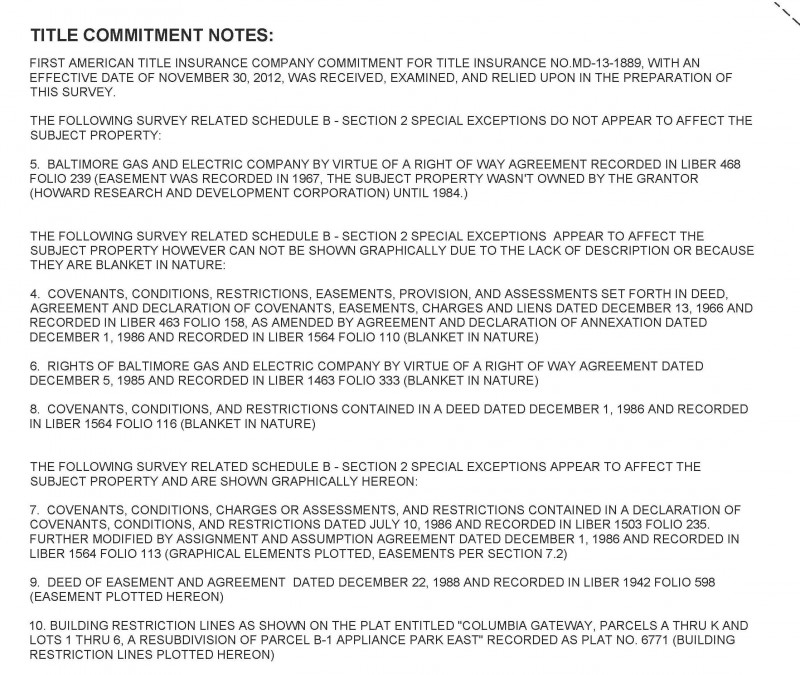
Posted : April 10, 2015 10:24 am

Translate
▼
English
Spanish
French
German
Italian
Portuguese
Russian
Chinese
Japanese
Korean
Arabic
Hindi
Dutch
Polish
Turkish
Vietnamese
Thai
Swedish
Danish
Finnish
Norwegian
Czech
Hungarian
Romanian
Greek
Hebrew
Indonesian
Malay
Ukrainian
Bulgarian
Croatian
Slovak
Slovenian
Serbian
Lithuanian
Latvian
Estonian
Here's an example:
With a description that can be mapped attached to a recorded lien, I can state if the property described in the instrument is the same property being surveyed, or part of the property being surveyed or none of the property being surveyed. I cannot state whether the lien affects the property. That's not for a surveyor to determine. So, along with such an item, I might state, "The property described in this instrument is the same as the subject tract".
I've been in the habit lately of listing all items under section 10 of Schedule B and adding the note "Outside the purview of a Professional Land Surveyor" for those items (such as tax liens) that I have no business commenting on. For the easements and encroachments that are not of record items, I note, "There is no visible evidence of easements on or crossing this tract except as shown" and similar wording for encroachments.
Posted : April 10, 2015 10:29 am

Translate
▼
English
Spanish
French
German
Italian
Portuguese
Russian
Chinese
Japanese
Korean
Arabic
Hindi
Dutch
Polish
Turkish
Vietnamese
Thai
Swedish
Danish
Finnish
Norwegian
Czech
Hungarian
Romanian
Greek
Hebrew
Indonesian
Malay
Ukrainian
Bulgarian
Croatian
Slovak
Slovenian
Serbian
Lithuanian
Latvian
Estonian
I'm very close to what Shawn does, but I use the phrase "Not a matter of survey" for things like taxes.
Posted : April 10, 2015 10:33 am

Translate
▼
English
Spanish
French
German
Italian
Portuguese
Russian
Chinese
Japanese
Korean
Arabic
Hindi
Dutch
Polish
Turkish
Vietnamese
Thai
Swedish
Danish
Finnish
Norwegian
Czech
Hungarian
Romanian
Greek
Hebrew
Indonesian
Malay
Ukrainian
Bulgarian
Croatian
Slovak
Slovenian
Serbian
Lithuanian
Latvian
Estonian
While not necessarily their biggest fan, the Bock & Clark Manual lists several good statements to add to the exceptions statements.
What I object to is declaring if an easement hinders or encombers a piece of property. I just draw the easement, but is seems to me that the effect of the easemsnt on the propert is purely a legal determination and that is not my job.
Yes, I list all of the easements and note "as shown hereon" or "contains noyhing that cam be graphically depicted hereon".
Posted : April 10, 2015 11:22 am

Translate
▼
English
Spanish
French
German
Italian
Portuguese
Russian
Chinese
Japanese
Korean
Arabic
Hindi
Dutch
Polish
Turkish
Vietnamese
Thai
Swedish
Danish
Finnish
Norwegian
Czech
Hungarian
Romanian
Greek
Hebrew
Indonesian
Malay
Ukrainian
Bulgarian
Croatian
Slovak
Slovenian
Serbian
Lithuanian
Latvian
Estonian
I've responded to clients or prospective clients that as far as hindering the property it is beyond the scope of the surveying profession to make that determination, all we show is if it is there, depicted, blanket locatable or not.
Posted : April 11, 2015 8:03 am

Translate
▼
English
Spanish
French
German
Italian
Portuguese
Russian
Chinese
Japanese
Korean
Arabic
Hindi
Dutch
Polish
Turkish
Vietnamese
Thai
Swedish
Danish
Finnish
Norwegian
Czech
Hungarian
Romanian
Greek
Hebrew
Indonesian
Malay
Ukrainian
Bulgarian
Croatian
Slovak
Slovenian
Serbian
Lithuanian
Latvian
Estonian
@shawn-billings Thank you for your post. What do you typically note when it is an interest in coal, lignite and other minerals? I'm not sure how these are supposed to be handled? Many times, yes our tract might fall within the tract being described in these documents, but do we concern ourselves with these types of exceptions??ÿ Thanks in advance!
Posted : September 21, 2020 5:36 pm
Translate
▼
English
Spanish
French
German
Italian
Portuguese
Russian
Chinese
Japanese
Korean
Arabic
Hindi
Dutch
Polish
Turkish
Vietnamese
Thai
Swedish
Danish
Finnish
Norwegian
Czech
Hungarian
Romanian
Greek
Hebrew
Indonesian
Malay
Ukrainian
Bulgarian
Croatian
Slovak
Slovenian
Serbian
Lithuanian
Latvian
Estonian
@greg-shoults-rpls what are the notes that you would use on something like matters of mineral rights and interest.
Posted : September 21, 2020 5:39 pm
Translate
▼
English
Spanish
French
German
Italian
Portuguese
Russian
Chinese
Japanese
Korean
Arabic
Hindi
Dutch
Polish
Turkish
Vietnamese
Thai
Swedish
Danish
Finnish
Norwegian
Czech
Hungarian
Romanian
Greek
Hebrew
Indonesian
Malay
Ukrainian
Bulgarian
Croatian
Slovak
Slovenian
Serbian
Lithuanian
Latvian
Estonian
@jeff-montanya Hi Jeff. If necessary, I would simply state that the subject tract is a part of the tract (or not a part of the tract) described in the reservation (or conveyance) of the minerals. As to the legal disposition of the interest, no, I would not comment as a surveyor. Only that the tract described includes all or part of the subject property, or not, if it is possible to determine from the record.
Posted : October 12, 2020 9:59 pm