Reading RPLS is free for the whole profession. Members post, reply, and get the members-only rooms.


Notifications
Clear all

Topic starter
Translate
▼
English
Spanish
French
German
Italian
Portuguese
Russian
Chinese
Japanese
Korean
Arabic
Hindi
Dutch
Polish
Turkish
Vietnamese
Thai
Swedish
Danish
Finnish
Norwegian
Czech
Hungarian
Romanian
Greek
Hebrew
Indonesian
Malay
Ukrainian
Bulgarian
Croatian
Slovak
Slovenian
Serbian
Lithuanian
Latvian
Estonian
We ran about a thousand feet of traverse in a generally north direction and when we checked the closure it was about 0.11 feet off. Nothing to brag about certainly. A closure of about 1 in 9000, with a high quality robot.
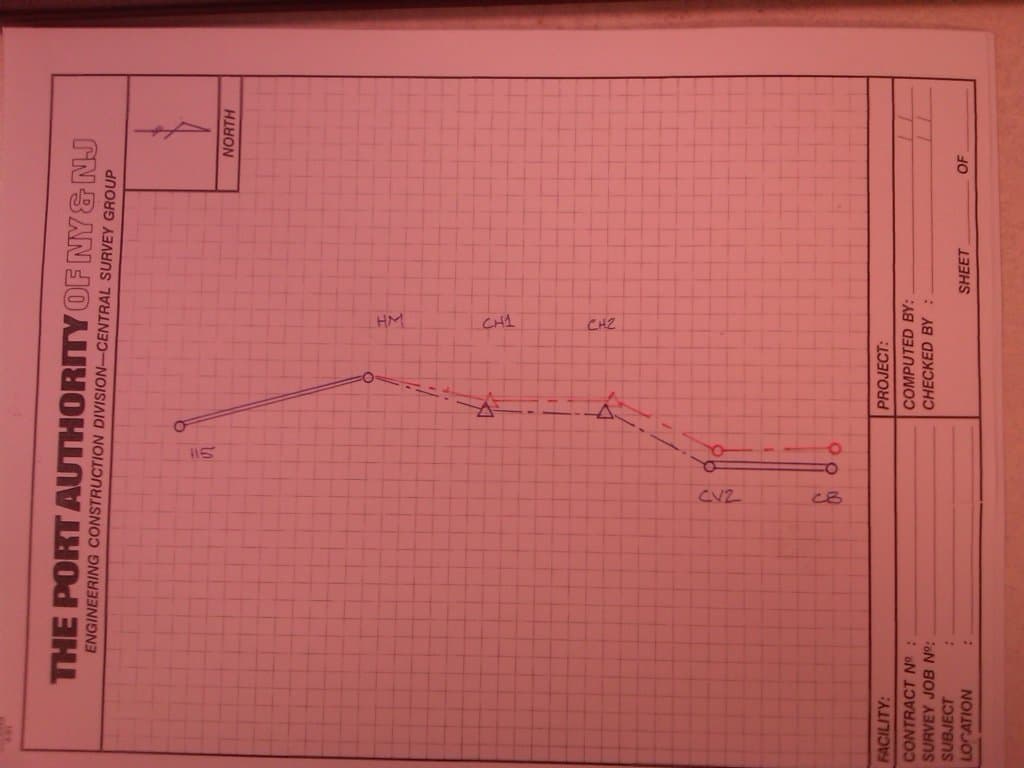
But, I was a little suspicious of our first set up point. "HM", the initial setup point is a cut on a concrete sidewalk, which had an 80 feet deep excavation to its west not long ago. So, I wanted to check the reverse closure; in effect starting in the north and running the traverse south. So we "transformed" the traverse CV2 over to the published CV2 and rotated about that point to match the published azimuth to CB. We then checked the closure at HM and it was 0.01 feet or about 1 in 100,000. And the coordinate for HM changed to the west a little more than 0.01 feet.
It was a perfect teaching moment for the crew running the traverse.
From zeros to heroes with a little intuition and some transformation magic.
Posted : August 3, 2015 7:07 am

Translate
▼
English
Spanish
French
German
Italian
Portuguese
Russian
Chinese
Japanese
Korean
Arabic
Hindi
Dutch
Polish
Turkish
Vietnamese
Thai
Swedish
Danish
Finnish
Norwegian
Czech
Hungarian
Romanian
Greek
Hebrew
Indonesian
Malay
Ukrainian
Bulgarian
Croatian
Slovak
Slovenian
Serbian
Lithuanian
Latvian
Estonian
Scott Zelenak, post: 330148, member: 327 wrote: We ran about a thousand feet of traverse in a generally north direction and when we checked the closure it was about 0.11 feet off. Nothing to brag about certainly. A closure of about 1 in 9000, with a high quality robot.
But, I was a little suspicious of our first set up point. "HM", the initial setup point is a cut on a concrete sidewalk, which had an 80 feet deep excavation to its west not long ago. So, I wanted to check the reverse closure; in effect starting in the north and running the traverse south. So we "transformed" the traverse CV2 over to the published CV2 and rotated about that point to match the published azimuth to CB. We then checked the closure at HM and it was 0.01 feet or about 1 in 100,000. And the coordinate for HM changed to the west a little more than 0.01 feet.
It was a perfect teaching moment for the crew running the traverse.
From zeros to heroes with a little intuition and some transformation magic.
:good::good:
Posted : August 3, 2015 7:11 am