Reading RPLS is free for the whole profession. Members post, reply, and get the members-only rooms.


Notifications
Clear all

Topic starter
Translate
▼
English
Spanish
French
German
Italian
Portuguese
Russian
Chinese
Japanese
Korean
Arabic
Hindi
Dutch
Polish
Turkish
Vietnamese
Thai
Swedish
Danish
Finnish
Norwegian
Czech
Hungarian
Romanian
Greek
Hebrew
Indonesian
Malay
Ukrainian
Bulgarian
Croatian
Slovak
Slovenian
Serbian
Lithuanian
Latvian
Estonian
I understand that the Vertical Centering Error, in Instrument Settings, defines the certainty with which you can measure up the instrument height.
But is the "Elev Diff Constant" used only for data in the DAT file that has certain types of records, such as DV or L records? If there are no such records in the analysis, is that parameter irrelevant. I've changed it under different circumstances, but haven't been able to make heads or tails of it.
Posted : January 24, 2016 2:26 pm

Translate
▼
English
Spanish
French
German
Italian
Portuguese
Russian
Chinese
Japanese
Korean
Arabic
Hindi
Dutch
Polish
Turkish
Vietnamese
Thai
Swedish
Danish
Finnish
Norwegian
Czech
Hungarian
Romanian
Greek
Hebrew
Indonesian
Malay
Ukrainian
Bulgarian
Croatian
Slovak
Slovenian
Serbian
Lithuanian
Latvian
Estonian
Posted : January 24, 2016 3:42 pm
Topic starter
Translate
▼
English
Spanish
French
German
Italian
Portuguese
Russian
Chinese
Japanese
Korean
Arabic
Hindi
Dutch
Polish
Turkish
Vietnamese
Thai
Swedish
Danish
Finnish
Norwegian
Czech
Hungarian
Romanian
Greek
Hebrew
Indonesian
Malay
Ukrainian
Bulgarian
Croatian
Slovak
Slovenian
Serbian
Lithuanian
Latvian
Estonian
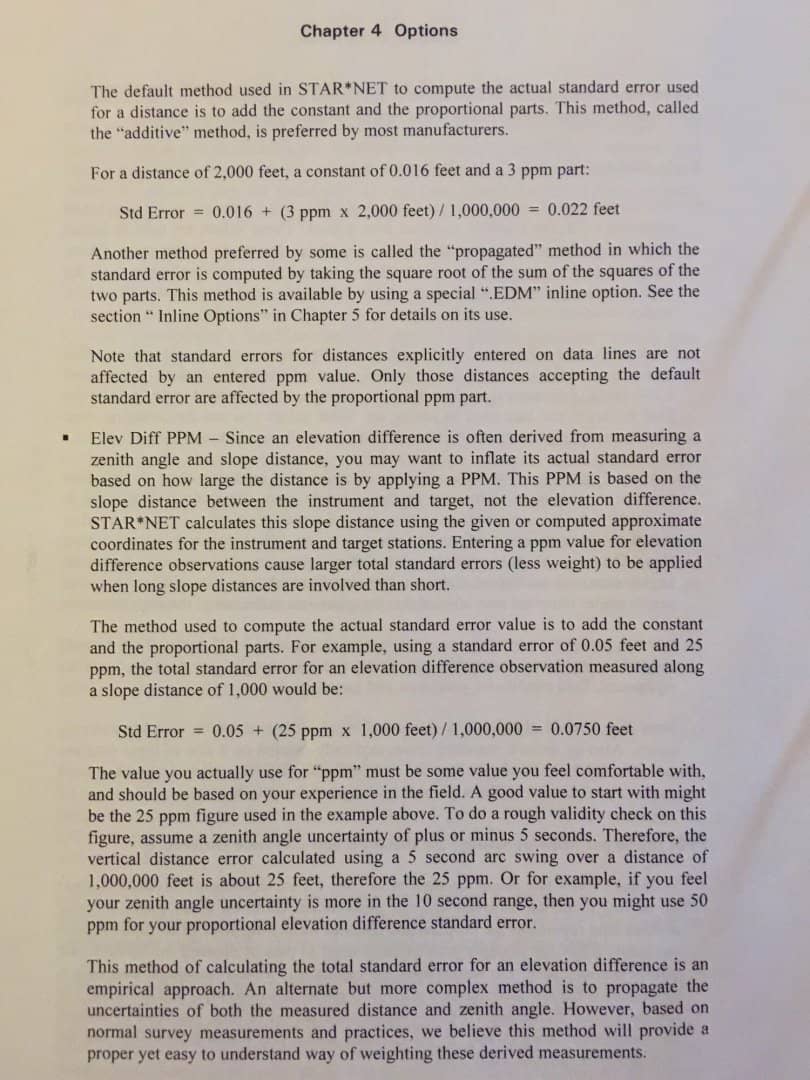
Thanks Scott. I've read that (more than once). But it jumps from Distance standard errors, to the PPM part of Vertical difference errors. It doesn't really talk about what to use for the Constant portion of the vertical error, or why.
Posted : January 24, 2016 3:49 pm
Translate
▼
English
Spanish
French
German
Italian
Portuguese
Russian
Chinese
Japanese
Korean
Arabic
Hindi
Dutch
Polish
Turkish
Vietnamese
Thai
Swedish
Danish
Finnish
Norwegian
Czech
Hungarian
Romanian
Greek
Hebrew
Indonesian
Malay
Ukrainian
Bulgarian
Croatian
Slovak
Slovenian
Serbian
Lithuanian
Latvian
Estonian
It's in the same ballpark as the scalar error in distance. Your instrument is rated at, say, 5mm +/- 5 ppm for distance. It's the same for elevations. You can assume a number or determine one by testing zeniths on an Invar rod, much like you could use the manufacturers numbers or determine your own on a base line for the distance constant and scalar.
Or, reverse engineer it, by tinkering with the values until you get a 1.00 for zenith angles in the adjustment.
Posted : January 24, 2016 3:59 pm
Topic starter
Translate
▼
English
Spanish
French
German
Italian
Portuguese
Russian
Chinese
Japanese
Korean
Arabic
Hindi
Dutch
Polish
Turkish
Vietnamese
Thai
Swedish
Danish
Finnish
Norwegian
Czech
Hungarian
Romanian
Greek
Hebrew
Indonesian
Malay
Ukrainian
Bulgarian
Croatian
Slovak
Slovenian
Serbian
Lithuanian
Latvian
Estonian
Got it. Thanks. Some time ago, I spent quite a bit of time determining the standard errors of my instrument...at least the horizontal directions, angles and distances. I never did anything to measure the verticals.
Can I assume that they'd be the same as for horizontals? (4 seconds for directions, 6.8 seconds for angles)?
Posted : January 24, 2016 6:49 pm
Translate
▼
English
Spanish
French
German
Italian
Portuguese
Russian
Chinese
Japanese
Korean
Arabic
Hindi
Dutch
Polish
Turkish
Vietnamese
Thai
Swedish
Danish
Finnish
Norwegian
Czech
Hungarian
Romanian
Greek
Hebrew
Indonesian
Malay
Ukrainian
Bulgarian
Croatian
Slovak
Slovenian
Serbian
Lithuanian
Latvian
Estonian
Quick answer; Like GPS, instrument verticals are usually worse than horizontals. It's got to do with the sensitivity of vertical angles to leveling errors and refraction.
Posted : January 25, 2016 7:45 am
Topic starter
Translate
▼
English
Spanish
French
German
Italian
Portuguese
Russian
Chinese
Japanese
Korean
Arabic
Hindi
Dutch
Polish
Turkish
Vietnamese
Thai
Swedish
Danish
Finnish
Norwegian
Czech
Hungarian
Romanian
Greek
Hebrew
Indonesian
Malay
Ukrainian
Bulgarian
Croatian
Slovak
Slovenian
Serbian
Lithuanian
Latvian
Estonian
Scott Zelenak, post: 354776, member: 327 wrote: Quick answer; Like GPS, instrument verticals are usually worse than horizontals. It's got to do with the sensitivity of vertical angles to leveling errors and refraction.
Now that I think of it, that makes a lot of sense. Where's Conrad or Kent when you need them, to devise a winter long project, including procedures to characterize Vertical Standard Errors associated with an instrument? 😀
Posted : January 25, 2016 7:50 am

Translate
▼
English
Spanish
French
German
Italian
Portuguese
Russian
Chinese
Japanese
Korean
Arabic
Hindi
Dutch
Polish
Turkish
Vietnamese
Thai
Swedish
Danish
Finnish
Norwegian
Czech
Hungarian
Romanian
Greek
Hebrew
Indonesian
Malay
Ukrainian
Bulgarian
Croatian
Slovak
Slovenian
Serbian
Lithuanian
Latvian
Estonian
The vertical index of most every digital instrument needs to be checked and adjusted thruout the day and at the beginning of every setup.
Posted : January 25, 2016 10:44 am
Topic starter
Translate
▼
English
Spanish
French
German
Italian
Portuguese
Russian
Chinese
Japanese
Korean
Arabic
Hindi
Dutch
Polish
Turkish
Vietnamese
Thai
Swedish
Danish
Finnish
Norwegian
Czech
Hungarian
Romanian
Greek
Hebrew
Indonesian
Malay
Ukrainian
Bulgarian
Croatian
Slovak
Slovenian
Serbian
Lithuanian
Latvian
Estonian
A Harris, post: 354810, member: 81 wrote: The vertical index of most every digital instrument needs to be checked and adjusted thruout the day and at the beginning of every setup.
I do that, but when making observations between one station and the next (not topo or stakeout), I always do D/R, which should eliminate vertical index errors. I thought this constant had more to do with the precision of the instrument measuring vertical angles. Has anyone ever determined how good the compensators in a total station are? They can't be perfect, can they?
Posted : January 26, 2016 7:34 pm