Reading RPLS is free for the whole profession. Members post, reply, and get the members-only rooms.


Notifications
Clear all

Topic starter
Translate
▼
English
Spanish
French
German
Italian
Portuguese
Russian
Chinese
Japanese
Korean
Arabic
Hindi
Dutch
Polish
Turkish
Vietnamese
Thai
Swedish
Danish
Finnish
Norwegian
Czech
Hungarian
Romanian
Greek
Hebrew
Indonesian
Malay
Ukrainian
Bulgarian
Croatian
Slovak
Slovenian
Serbian
Lithuanian
Latvian
Estonian
I was working in Canada this week, doing a survey in a remote area using Trimble RTX (real time over satellite). Since the RTX system uses ITRF2008, epoch 2005.0, I wanted to make sure that I apply the correct transformation back in the office. I looked up the nearest "High Precision 3D" station on the NRCAN website. Here is the station:
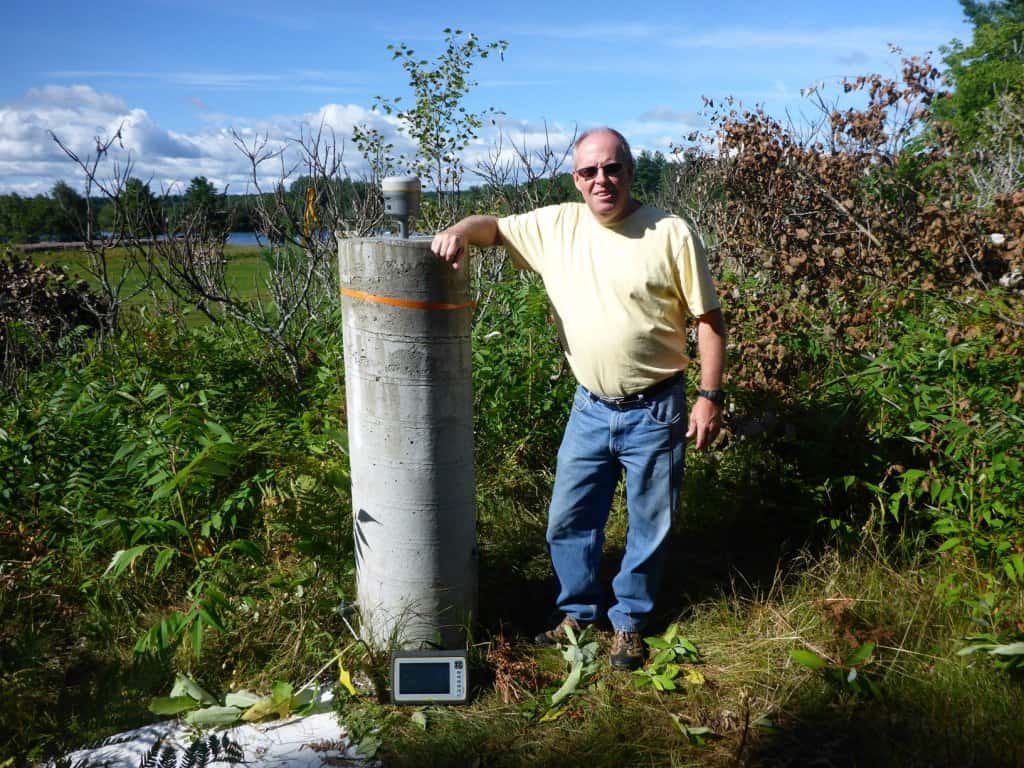
It is near a highway, but you can't see it from the highway. I didn't have a tribrach with me, so I had to put the R10 directly on the threaded bolt, which could introduce a small H error, probably within a few mm. There is a metal plate on top of the monument with a 5/8" threaded rod protruding about 0.1 meters. This is one of their CBN stations (equivalent to our FBN?). If you look down below knee level, there are two metal objects protruding from the monument.
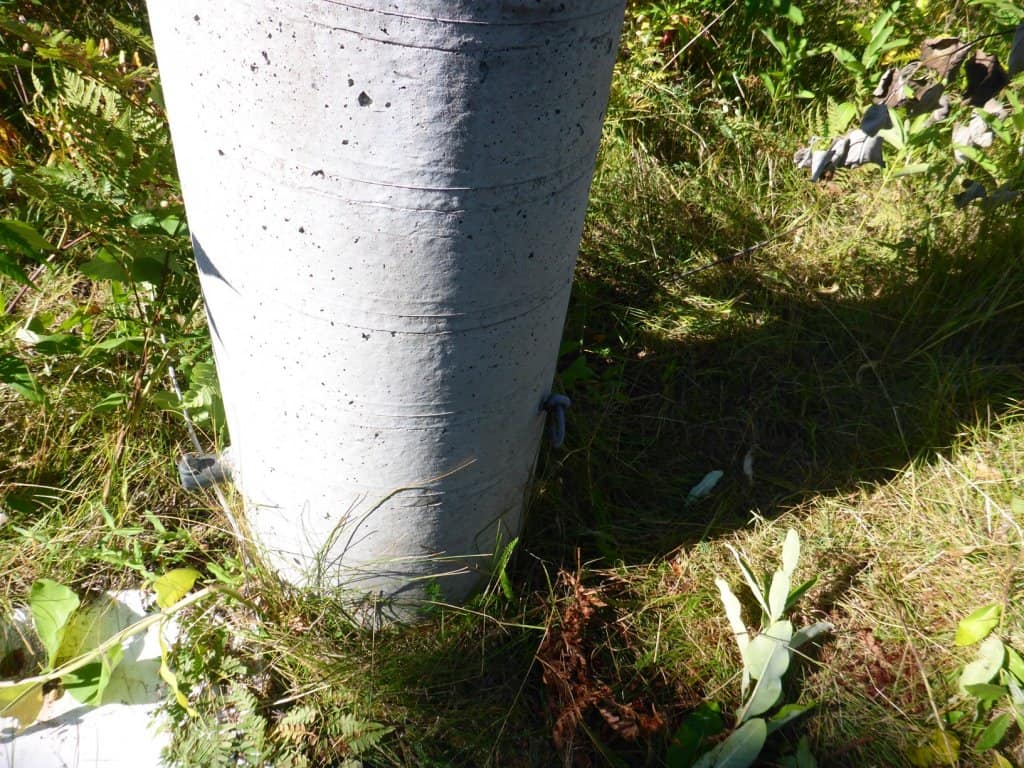
The one on the left is an elevation reference point (benchmark):
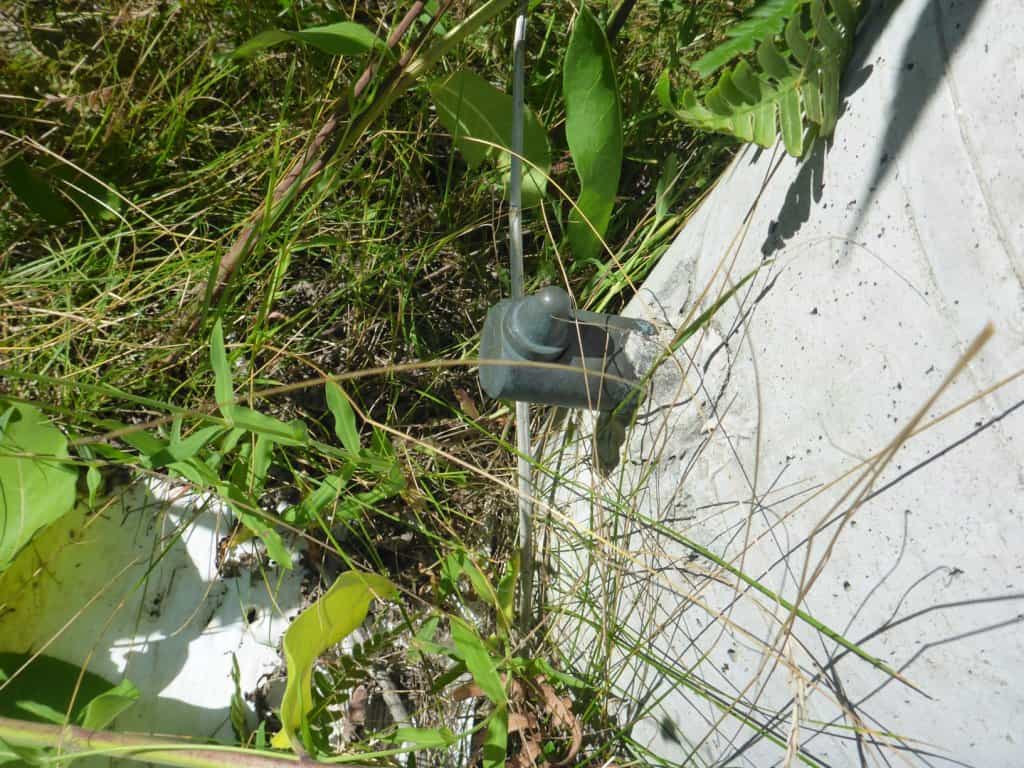
The one on the right is a metal ring to secure equipment against theft, I assume.
The bolt on top (where the R10 is) and the mark on the side are both first order benchmarks. There are three other first order benchmarks in bedrock within 100 meters or so.
This is probably the best monument I have ever come across. I use a lot of pedestals in my work (deformation surveys), and have two on my property, but none with the side mark and the tie down ring, and they are not quite as massive. And I also like the fact that there are other BM's nearby to check this one.
On their web page you can select the datum and epoch and it will provide a coordinate. I had the precisions set for 0.05 m H/0.10 m V, and the R10 took about 10 minutes to get below those tolerances. I did a three minute observation (observed control point). Using their published ITRF2008 epoch 2005.0 coordinate, the horizontal difference was 0.009 m, the vertical was 0.08 m. Precisions for the stored point were 0.04 m H and 0.07 m V. The project is somewhat loose, 40 cm accuracy is acceptable on the points surveyed (photo control), but I wanted to get 0.05 m H/0.10 m V just to be safe.
Why can't we set mons like these???
Posted : August 7, 2015 8:44 am

Translate
▼
English
Spanish
French
German
Italian
Portuguese
Russian
Chinese
Japanese
Korean
Arabic
Hindi
Dutch
Polish
Turkish
Vietnamese
Thai
Swedish
Danish
Finnish
Norwegian
Czech
Hungarian
Romanian
Greek
Hebrew
Indonesian
Malay
Ukrainian
Bulgarian
Croatian
Slovak
Slovenian
Serbian
Lithuanian
Latvian
Estonian
Nice to see something that solid, but after years of looking at monuments and measuring to them, old and new, I'm beginning to wonder if any of them are stable in the long run.
The one you found certainly appears solid. Do you know how deep it goes and what it sits on top of? I have done second order leveling into first order vertical USC&GS monumuments that had definitely sunk about 0.2 feet in 60 years. Some of the more recent first order NGS points seemed a bit questionable vertically although it is really hard to tell if something has settled or not if the error is not too large. These monuments were the newer rods that were driven down to "refusal". The monuments that had sunk several tenths were in sandy soil with sand that probably went down quite deep. They were concrete pillars also but quite a bit smaller. I expect they were dug in about three feet with one foot projecting above ground. Regardless of size it seems that a relatively smooth sided concrete cylinder, if projecting above the ground would eventually begin to settle from isostatic loading forces.
With the City of Albuquerque we set two monuments for our Real-Time network that looked much like the Canadian one in your picture. They were a little larger in diameter, projected about 7 feet above ground and about 8 feet, as I recall, below ground. I will always wonder what their elevations will be one hundred years from now. They were set in sandy soils that were quite deep.
It seems to me the Plate Boundary Observatory has the best approach. They drill down to "bedrock". "Bedrock" I suppose can be anything as solid as a granite monolith or a thick sedimentary layer of limestone or sandstone. Regardless, I expect being afixed to bedrock is the best way to ensure stability and monitor plate tectonic motion rather than local subsidence or other displacement. In the Rio Grande valley in Albuquerque the unconsolidated sand alluvium goes down 15,000 feet so it's an awful long ways to the granite underneath. I personally doubt there is a practical method of setting a monument in that type of geology that would be stable in the long term, if the term were long enough. There are of course other similar areas such as the U.S. Gulf coastal plain which is a big huge wedge of clastics which I don't think are consolidated.
Anyway, glad to see the Canadians putting some time and energy into monuments that are certainly far better that a lot that you see. And thanks for posting.
Posted : August 7, 2015 12:48 pm
Topic starter
Translate
▼
English
Spanish
French
German
Italian
Portuguese
Russian
Chinese
Japanese
Korean
Arabic
Hindi
Dutch
Polish
Turkish
Vietnamese
Thai
Swedish
Danish
Finnish
Norwegian
Czech
Hungarian
Romanian
Greek
Hebrew
Indonesian
Malay
Ukrainian
Bulgarian
Croatian
Slovak
Slovenian
Serbian
Lithuanian
Latvian
Estonian
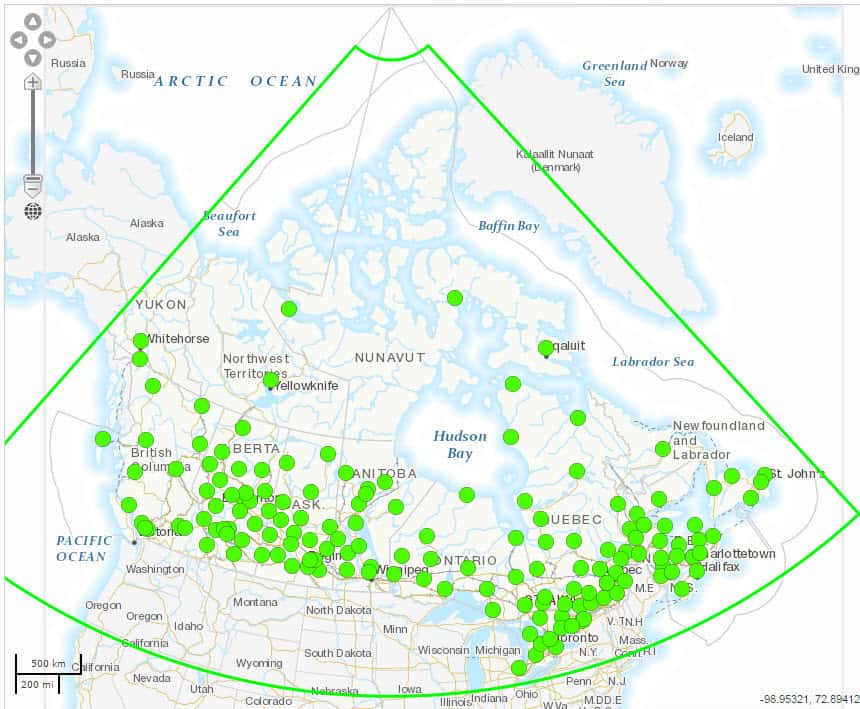
There is outcropping bedrock all around, and the description says it is on bedrock. It appears that all stations in the CBN (156) are pillars. Here is a map:
Posted : August 7, 2015 12:57 pm

Translate
▼
English
Spanish
French
German
Italian
Portuguese
Russian
Chinese
Japanese
Korean
Arabic
Hindi
Dutch
Polish
Turkish
Vietnamese
Thai
Swedish
Danish
Finnish
Norwegian
Czech
Hungarian
Romanian
Greek
Hebrew
Indonesian
Malay
Ukrainian
Bulgarian
Croatian
Slovak
Slovenian
Serbian
Lithuanian
Latvian
Estonian
I'd watch my back there must be a dozer headed your way for sure. Around here they take them out with snow plows.
Nothing that nice can last for long.
T.W.
Posted : August 7, 2015 3:09 pm

Translate
▼
English
Spanish
French
German
Italian
Portuguese
Russian
Chinese
Japanese
Korean
Arabic
Hindi
Dutch
Polish
Turkish
Vietnamese
Thai
Swedish
Danish
Finnish
Norwegian
Czech
Hungarian
Romanian
Greek
Hebrew
Indonesian
Malay
Ukrainian
Bulgarian
Croatian
Slovak
Slovenian
Serbian
Lithuanian
Latvian
Estonian
John Hamilton, post: 330863, member: 640 wrote: I was working in Canada this week, doing a survey in a remote area using Trimble RTX (real time over satellite). Since the RTX system uses ITRF2008, epoch 2005.0, I wanted to make sure that I apply the correct transformation back in the office. I looked up the nearest "High Precision 3D" station on the NRCAN website. Here is the station:
It is near a highway, but you can't see it from the highway. I didn't have a tribrach with me, so I had to put the R10 directly on the threaded bolt, which could introduce a small H error, probably within a few mm. There is a metal plate on top of the monument with a 5/8" threaded rod protruding about 0.1 meters. This is one of their CBN stations (equivalent to our FBN?). If you look down below knee level, there are two metal objects protruding from the monument.
The one on the left is an elevation reference point (benchmark):
The one on the right is a metal ring to secure equipment against theft, I assume.
The bolt on top (where the R10 is) and the mark on the side are both first order benchmarks. There are three other first order benchmarks in bedrock within 100 meters or so.
This is probably the best monument I have ever come across. I use a lot of pedestals in my work (deformation surveys), and have two on my property, but none with the side mark and the tie down ring, and they are not quite as massive. And I also like the fact that there are other BM's nearby to check this one.
On their web page you can select the datum and epoch and it will provide a coordinate. I had the precisions set for 0.05 m H/0.10 m V, and the R10 took about 10 minutes to get below those tolerances. I did a three minute observation (observed control point). Using their published ITRF2008 epoch 2005.0 coordinate, the horizontal difference was 0.009 m, the vertical was 0.08 m. Precisions for the stored point were 0.04 m H and 0.07 m V. The project is somewhat loose, 40 cm accuracy is acceptable on the points surveyed (photo control), but I wanted to get 0.05 m H/0.10 m V just to be safe.
Why can't we set mons like these???
++++++++++++++++++++++++++++++++++++++++++++++++
John-
I've a few other pics from a Canadian base line but I don't know how to post them to here from my file.
Any hints ?
TU
Derek
PS-
You might check your profile.
Posted : August 7, 2015 3:44 pm

Translate
▼
English
Spanish
French
German
Italian
Portuguese
Russian
Chinese
Japanese
Korean
Arabic
Hindi
Dutch
Polish
Turkish
Vietnamese
Thai
Swedish
Danish
Finnish
Norwegian
Czech
Hungarian
Romanian
Greek
Hebrew
Indonesian
Malay
Ukrainian
Bulgarian
Croatian
Slovak
Slovenian
Serbian
Lithuanian
Latvian
Estonian
Interesting monument.
We have EDM base lines on pillars here.
I've seen our Hydro Tasmania (HEC) pillars dotted about, used in dam construction.
Around here we use such as farm gate posts. Hinges off that bottom support spigot.
I can envisage a big guard dog tied to the ring.
@Derek you click Upload a file at bottom right of the box we type these posts in.
Took me a while as often that part is 'below the horizon' as I post from a tablet.
Posted : August 7, 2015 4:43 pm

Translate
▼
English
Spanish
French
German
Italian
Portuguese
Russian
Chinese
Japanese
Korean
Arabic
Hindi
Dutch
Polish
Turkish
Vietnamese
Thai
Swedish
Danish
Finnish
Norwegian
Czech
Hungarian
Romanian
Greek
Hebrew
Indonesian
Malay
Ukrainian
Bulgarian
Croatian
Slovak
Slovenian
Serbian
Lithuanian
Latvian
Estonian

That's funny...that ol' "lighterwood" post has been around since the late 1800's. I'd say we do pretty good here in the states...
Posted : August 7, 2015 5:00 pm
Topic starter
Translate
▼
English
Spanish
French
German
Italian
Portuguese
Russian
Chinese
Japanese
Korean
Arabic
Hindi
Dutch
Polish
Turkish
Vietnamese
Thai
Swedish
Danish
Finnish
Norwegian
Czech
Hungarian
Romanian
Greek
Hebrew
Indonesian
Malay
Ukrainian
Bulgarian
Croatian
Slovak
Slovenian
Serbian
Lithuanian
Latvian
Estonian
DEREK G. GRAHAM OLS OLIP, post: 330918, member: 285 wrote: ++++++++++++++++++++++++++++++++++++++++++++++++
John-I've a few other pics from a Canadian base line but I don't know how to post them to here from my file.
Any hints ?
TU
Derek
PS-
You might check your profile.
Derek...Thanks for pointing that out. I would have had to buy all new clothes.
Posted : August 7, 2015 5:15 pm

Translate
▼
English
Spanish
French
German
Italian
Portuguese
Russian
Chinese
Japanese
Korean
Arabic
Hindi
Dutch
Polish
Turkish
Vietnamese
Thai
Swedish
Danish
Finnish
Norwegian
Czech
Hungarian
Romanian
Greek
Hebrew
Indonesian
Malay
Ukrainian
Bulgarian
Croatian
Slovak
Slovenian
Serbian
Lithuanian
Latvian
Estonian
On the issues related to GPS site monumentation, check out the nice summary with links at: https://igscb.jpl.nasa.gov/network/monumentation.html
Lots of interesting technical details. While the UNAVCO sites are great for geophysical work, they are expensive and difficult to establish. The linked document has a link to an NGS monument guideline document (oddly not available through their site) that is relatively inexpensive and relatively easy to install.
Posted : August 7, 2015 5:58 pm
Translate
▼
English
Spanish
French
German
Italian
Portuguese
Russian
Chinese
Japanese
Korean
Arabic
Hindi
Dutch
Polish
Turkish
Vietnamese
Thai
Swedish
Danish
Finnish
Norwegian
Czech
Hungarian
Romanian
Greek
Hebrew
Indonesian
Malay
Ukrainian
Bulgarian
Croatian
Slovak
Slovenian
Serbian
Lithuanian
Latvian
Estonian
Thank you Richard.
On the theme of "A picture is worth a thousand words", I'll be brief.
These are pics of part of the Conestogo Base Line that was set up by the Ontario/Canadian government to make certain all our 'rubber boot per second' measurements are equal.
So far, so good with our EDM and GPS equipment and, our rubber boots are all calibrated correctly.
Cheers,
Derek
Posted : August 10, 2015 2:50 pm
Translate
▼
English
Spanish
French
German
Italian
Portuguese
Russian
Chinese
Japanese
Korean
Arabic
Hindi
Dutch
Polish
Turkish
Vietnamese
Thai
Swedish
Danish
Finnish
Norwegian
Czech
Hungarian
Romanian
Greek
Hebrew
Indonesian
Malay
Ukrainian
Bulgarian
Croatian
Slovak
Slovenian
Serbian
Lithuanian
Latvian
Estonian
Derek I notice the overhead power lines.
I've occasionally had no choice but to observe under them with GPS.
Curious how your results compared.
I've always been wary.
I was a bit surprised they set a base line under them, but if in EDM days probably didn't matter.
I like your sign.
Posted : August 10, 2015 10:07 pm