Reading RPLS is free for the whole profession. Members post, reply, and get the members-only rooms.


Notifications
Clear all
GNSS & Geodesy
5
Posts
3
Users
0
Reactions
501
Views

Topic starter
Translate
▼
English
Spanish
French
German
Italian
Portuguese
Russian
Chinese
Japanese
Korean
Arabic
Hindi
Dutch
Polish
Turkish
Vietnamese
Thai
Swedish
Danish
Finnish
Norwegian
Czech
Hungarian
Romanian
Greek
Hebrew
Indonesian
Malay
Ukrainian
Bulgarian
Croatian
Slovak
Slovenian
Serbian
Lithuanian
Latvian
Estonian
I have one file from an R10 that will not process in PAGES. I upload it to OPUS, and I get this screen:
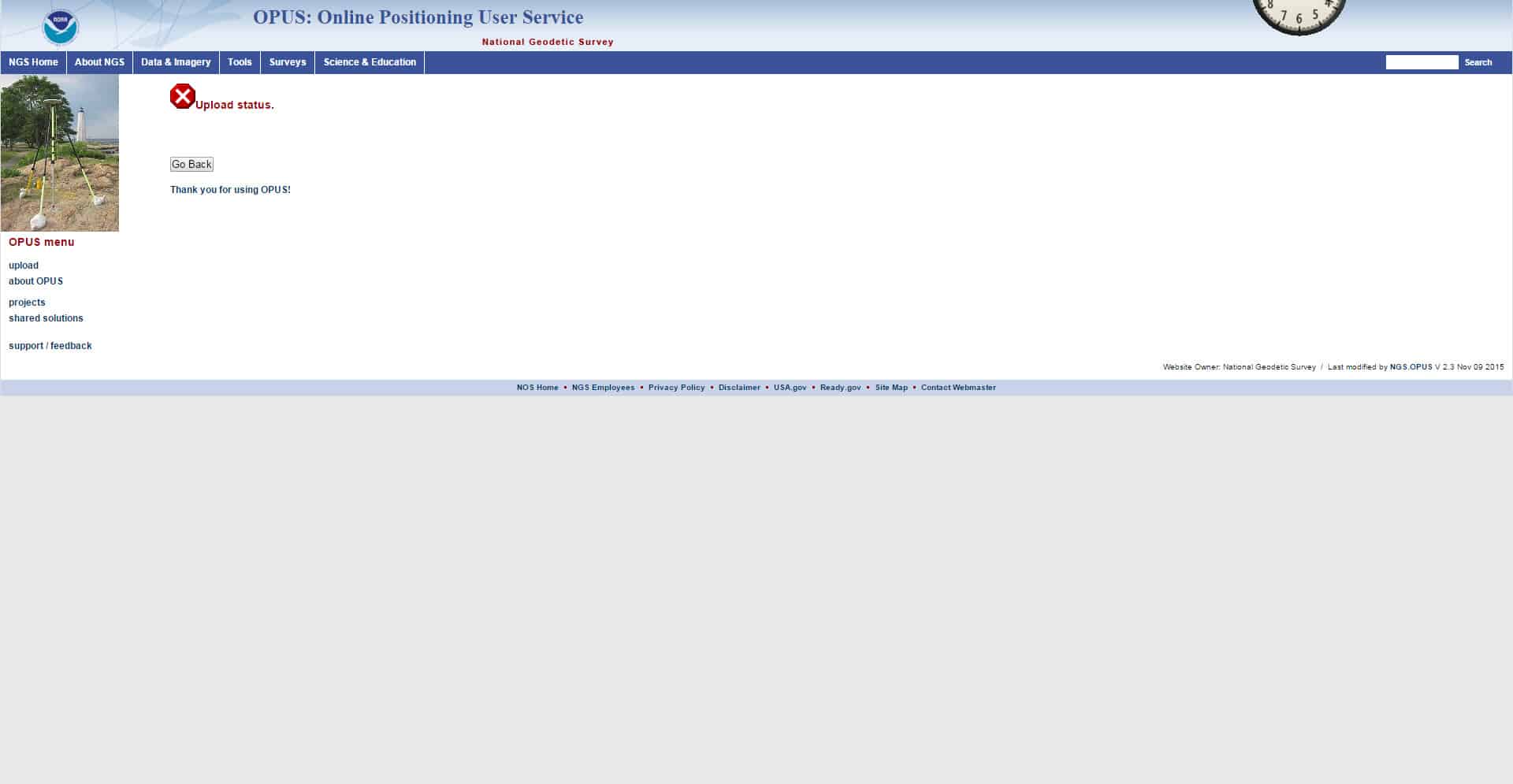
I have not seen that screen before, but I am not a frequent user of OPUS. I converted the file using both teqc and trimble "convert to rinex". They both have the same result when I upload. The files are quite different. The teqc file has L1, L2, C1, P1, P2, S1 and S2. However, most satellites (all except one, SV02) have only L1, C1, S1 present. SV02 has L1, L2, C1, P2, S1, and S2. The trimble version has 5 observables, C1, C2, L1, L2, and P2, with most of the satellites having all 5.
This data processes just fine in TBC and RTX upload. This is not my receiver, I got the data from a client. The next day the data from that the same receiver on the same point processed just fine in pages. I am not getting a lot of feedback from pages as to what is wrong, and OPUS just gives me that big red X. In pages I am processing with three other stations, and I just get a combined.sum file that says 3 stations.
Edit: I just cut 1 hour out of the middle of the file, and uploaded to OPUS-RS. It accepted it, but I got the "fewer than 3 useable reference stations remain. Aborting" message. This file is from more than 1 month ago, near Philadelphia, so i know there are plenty of CORS around and the ephemeris is there, etc.
I really need to process it in pages, it is part of an FAA PACS/SACS survey, but I cannot figure out why it is failing. Hmmm...the next day the file created by teqc has more observables present. I don't believe they did anything different.
Posted : November 11, 2015 2:34 pm

Translate
▼
English
Spanish
French
German
Italian
Portuguese
Russian
Chinese
Japanese
Korean
Arabic
Hindi
Dutch
Polish
Turkish
Vietnamese
Thai
Swedish
Danish
Finnish
Norwegian
Czech
Hungarian
Romanian
Greek
Hebrew
Indonesian
Malay
Ukrainian
Bulgarian
Croatian
Slovak
Slovenian
Serbian
Lithuanian
Latvian
Estonian
Check the apriori location in the RINEX header:
2473651.8238 -5524265.6134 2004130.3899 APPROX POSITION XYZ
is it crazy?
M
Posted : November 11, 2015 3:18 pm
Topic starter
Translate
▼
English
Spanish
French
German
Italian
Portuguese
Russian
Chinese
Japanese
Korean
Arabic
Hindi
Dutch
Polish
Turkish
Vietnamese
Thai
Swedish
Danish
Finnish
Norwegian
Czech
Hungarian
Romanian
Greek
Hebrew
Indonesian
Malay
Ukrainian
Bulgarian
Croatian
Slovak
Slovenian
Serbian
Lithuanian
Latvian
Estonian
They are within 1 m in all three components day-to-day (i.e. day 280 matches day 281 to better than 1 m). Good thought, though.
After looking at the specs for PACS/SACS surveys, I can do without this station being double occupied (I have 2 other BM's and one other HARN, plus a CORS within 5 km), but I still would like to know what happened
Posted : November 11, 2015 3:20 pm
Topic starter
Translate
▼
English
Spanish
French
German
Italian
Portuguese
Russian
Chinese
Japanese
Korean
Arabic
Hindi
Dutch
Polish
Turkish
Vietnamese
Thai
Swedish
Danish
Finnish
Norwegian
Czech
Hungarian
Romanian
Greek
Hebrew
Indonesian
Malay
Ukrainian
Bulgarian
Croatian
Slovak
Slovenian
Serbian
Lithuanian
Latvian
Estonian
Found the (stupid) problem...there was 35 seconds between the first and second epochs in the file, and then 5 second epochs for the rest of the file. Deleted the first epoch, and OPUS took it right in. Not sure what happened there, or even why they were doing 5 s epochs.
It would have been nice if OPUS returned some type of useful informative error message.
Thanks to William Stone (NGS SW Regional Geodetic Advisor) for finding that. Hope he doesn't mind that I named him, but he deserves thanks for finding that.
PAGES didn't give me any indication of what was wrong either. Pages is the processor behind OPUS-S, but it never got that far in OPUS, it was rejected in the upload process. Obviously it drew a foul in OPUS, why couldn't they tell the user WHY?
Posted : November 12, 2015 3:24 pm

Translate
▼
English
Spanish
French
German
Italian
Portuguese
Russian
Chinese
Japanese
Korean
Arabic
Hindi
Dutch
Polish
Turkish
Vietnamese
Thai
Swedish
Danish
Finnish
Norwegian
Czech
Hungarian
Romanian
Greek
Hebrew
Indonesian
Malay
Ukrainian
Bulgarian
Croatian
Slovak
Slovenian
Serbian
Lithuanian
Latvian
Estonian
OPUS-S and OPUS-RS assume you send good data and that you know what good data looks like.
It is the easiest thing in the world to open a RINEX file and actually look at the data. You should do it before sending it the first time. If that is too much to ask you should do it after a file is aborted. The reason given for the abort is not always exactly what the problem is.
In a majority of cases the data is good after the first few epochs. One way to alleviate that is to turn on the receiver and start collecting data before you have fine tuned the rod for plumbness and other routine work. Then just start a new file .
Consider it the same thing you do when setting up an instrument on a tripod. After you have set your legs, leveled up, re-centered over the point and zeroed on your backsight, you set up your field notes, check your radio batteries, give instructions to your assistant. Having done all that as the assistant walks to the first shot, your tripod has settled in, you reset the legs and go through the whole routine again. You do not wait until you get back in the office and say, "maybe my compensators were a bit off, I guess I have to do an LS adjustment now".
Proprietary software is designed to give you results and will switch to an L1 solution if L2 is not there. OPUS-S is
designed to give L2 solutions and stops if L2 is not there. OPUS-RS is designed to give solutions with shorter length files and makes up for length by using additional observables, C1/P1 and P2/C2.
Paul in PA
Posted : November 12, 2015 7:18 pm
