Reading RPLS is free for the whole profession. Members post, reply, and get the members-only rooms.

Notifications
Clear all

Topic starter
Translate
▼
English
Spanish
French
German
Italian
Portuguese
Russian
Chinese
Japanese
Korean
Arabic
Hindi
Dutch
Polish
Turkish
Vietnamese
Thai
Swedish
Danish
Finnish
Norwegian
Czech
Hungarian
Romanian
Greek
Hebrew
Indonesian
Malay
Ukrainian
Bulgarian
Croatian
Slovak
Slovenian
Serbian
Lithuanian
Latvian
Estonian
How I research legal issues is like this...
First read one of the encyclopedias and treatises to get an idea of the various principles and what they are...such as control of monuments. These are written by Attorneys so it's like a free consult. The treatises are more detailed and may contain examples.
Then using the Westlaw topic and key numbers go get a list of headnotes. Headnotes are short statements of a principle or sometimes a fact and how the court applied the law to that fact. Westlaw classifies these into their key cite topic hierarchy. One of the major topics is Boundaries which is divided into two Parts, Deeds and Establishment. There is also a major topic Deeds which is huge because it covers everything in Deeds not just location, so I drill down and get some of the location key topics.
My latest project is downloading all of the Boundary headnotes for all fifty states and DC into individual PDF files. I also download a file of cases which have a Boundaries headnotes. This is not comprehensive because there may be a lot more relevant cases under Deeds. I am organizing them into State folders which are in folders by the West National Reporter (e.g. Nevada is in Pacific and Florida is in Southern).
Once you learn some basics about the principles (for example monuments control course and distance) then the headnotes for a State are a very efficient way to see how that State's courts have defined that issue. There are variations. If a headnote seems particularly interesting (or the short case summary below) then the case can be pulled up and read.
So, for example, take Massachusetts (this is not intended to be a restatement of Massachusetts law or cover every possible nuance). Massachusetts headnotes does not distinguish between called for and uncalled monuments as many western states do. Just because a monument is uncalled for is not necessarily fatal to its control unless it is proven to be set for some other reason or by strangers to the Deed. It seems like they have merged establishment into the description rule of construction. Acquiescence exists but as evidence of the original boundary, not as a stand alone doctrine. Their courts seem to be unfriendly to boundary agreements too. The newest cases under acquiescence and agreements are very old, the doctrines as stand alones have died out. The other interesting thing I noticed is they have very old cases where the Appellate Court approved of testimony of Surveyors as experts. The earliest case I have is from 1826:
443. Davis v. Mason
Supreme Judicial Court of Massachusetts. January 1, 1826 4 Pick. 156
Headnote: The evidence of a practical surveyor was admitted on a question whether certain piles of stones and marks on trees were monuments of boundaries.
Document Summary: Since hearing the argument in this case, we have decided in a case at Cambridge, that by St. 1820, c. 79, the legislature intended by the terms real action to comprehend the action of quare clausum fregit, so far as regards the right of appeal. The reasons for this decision will appear in the report of that case. The title of the plaintiff was primaíâ facie sufficiently proved by the records of the proprietors, showing a location of the locus in quo to John Child, under whom the plaintiff claims. A location by the proprietors imports a possession, the lot being laid out by a survey to the person to whom the location is made. The objection that extracts only of the records were used in evidence, is sufficiently answered by the fact admitted, that the proprietors' records were in the court room and at the disposal of the defendant during the trial. The testimony of Holman was rightly admitted. He, being a practical surveyor, with long experience, would have acquired a skill in...
Posted : January 21, 2017 11:49 am
Topic starter
Translate
▼
English
Spanish
French
German
Italian
Portuguese
Russian
Chinese
Japanese
Korean
Arabic
Hindi
Dutch
Polish
Turkish
Vietnamese
Thai
Swedish
Danish
Finnish
Norwegian
Czech
Hungarian
Romanian
Greek
Hebrew
Indonesian
Malay
Ukrainian
Bulgarian
Croatian
Slovak
Slovenian
Serbian
Lithuanian
Latvian
Estonian
Acquiescence:
444. Ryan v. Stavros
Supreme Judicial Court of Massachusetts, Worcester. December 10, 1964 348 Mass. 251
Headnote: ÛÏDoctrine of acquiescenceÛ with regard to boundary disputes provides merely that where description in deed is of doubtful or ambiguous import, extrinsic evidence is admissible to show construction given to the deed by the parties and their predecessors in title as manifested by their acts.
9 Cases that cite this legal issue
Document Summary: Suit to establish title to strip of land by adverse possession or to acquire right by prescription to occupy it and park vehicles there and to require removal of asphalt berm and restoration of plaintiffs' land to its former condition. The Superior Court, Ford, J., took no action on plaintiffs' objections to master's report or on motion to recommit but entered interlocutory decree allowing motion for final decree dismissing the bill, and entered such a final decree, and plaintiffs appealed. The Supreme Judicial Court, Spiegel, J., held that adjoining owner's action of speaking to owners, arranging for painting of curbstone and of removal of papers in disputed area, and placing of wooden horses in area for a few hours on two occasions when owners' premises were closed did not have effect of making owners' use of the easement no longer adverse to adjoining owner but permissive and did not have effect of termination of the prescriptive easement by...
Posted : January 21, 2017 11:55 am
Topic starter
Translate
▼
English
Spanish
French
German
Italian
Portuguese
Russian
Chinese
Japanese
Korean
Arabic
Hindi
Dutch
Polish
Turkish
Vietnamese
Thai
Swedish
Danish
Finnish
Norwegian
Czech
Hungarian
Romanian
Greek
Hebrew
Indonesian
Malay
Ukrainian
Bulgarian
Croatian
Slovak
Slovenian
Serbian
Lithuanian
Latvian
Estonian
Here is a page...
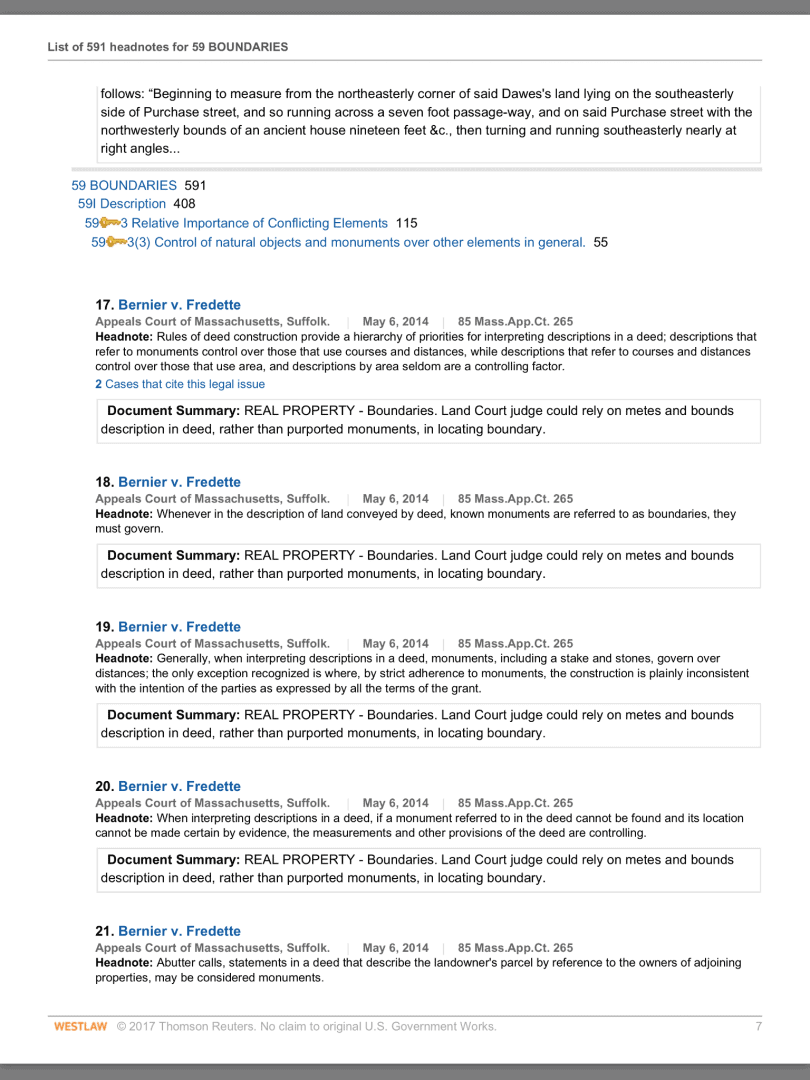
They also publish sets of books with the headnotes known as Digests.
Posted : January 21, 2017 11:59 am
Topic starter
Translate
▼
English
Spanish
French
German
Italian
Portuguese
Russian
Chinese
Japanese
Korean
Arabic
Hindi
Dutch
Polish
Turkish
Vietnamese
Thai
Swedish
Danish
Finnish
Norwegian
Czech
Hungarian
Romanian
Greek
Hebrew
Indonesian
Malay
Ukrainian
Bulgarian
Croatian
Slovak
Slovenian
Serbian
Lithuanian
Latvian
Estonian

Here are a couple of California pages:
Posted : January 21, 2017 12:11 pm
Topic starter
Translate
▼
English
Spanish
French
German
Italian
Portuguese
Russian
Chinese
Japanese
Korean
Arabic
Hindi
Dutch
Polish
Turkish
Vietnamese
Thai
Swedish
Danish
Finnish
Norwegian
Czech
Hungarian
Romanian
Greek
Hebrew
Indonesian
Malay
Ukrainian
Bulgarian
Croatian
Slovak
Slovenian
Serbian
Lithuanian
Latvian
Estonian
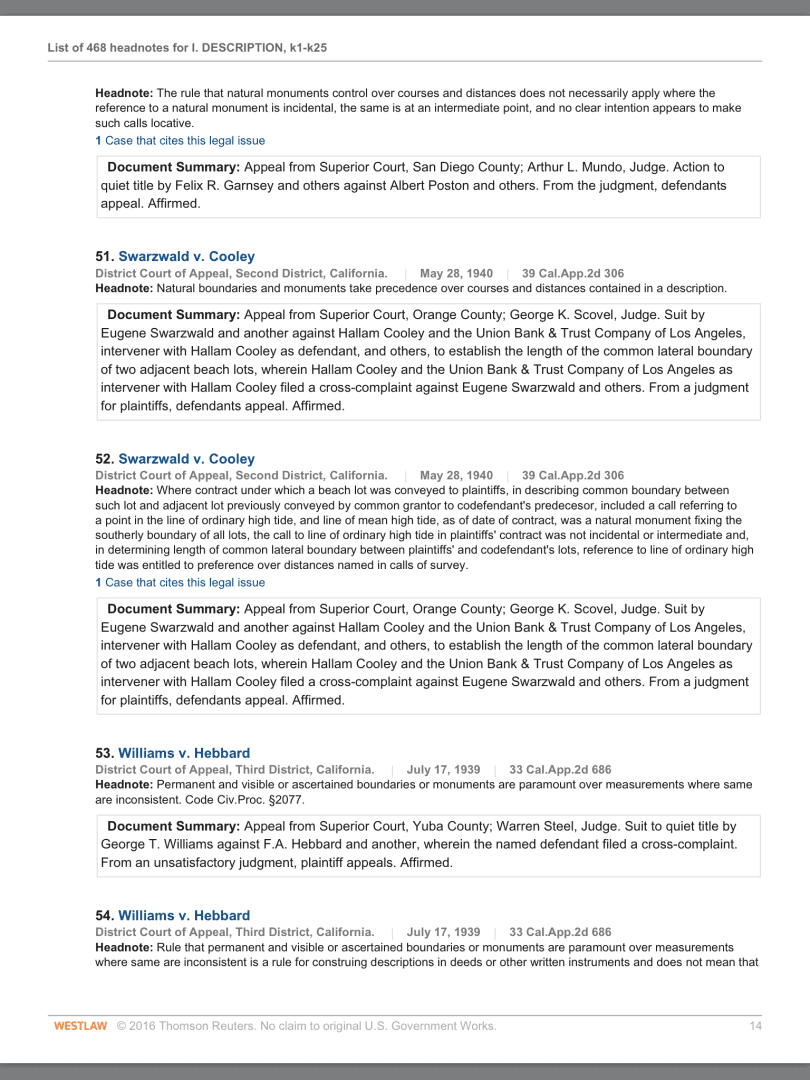
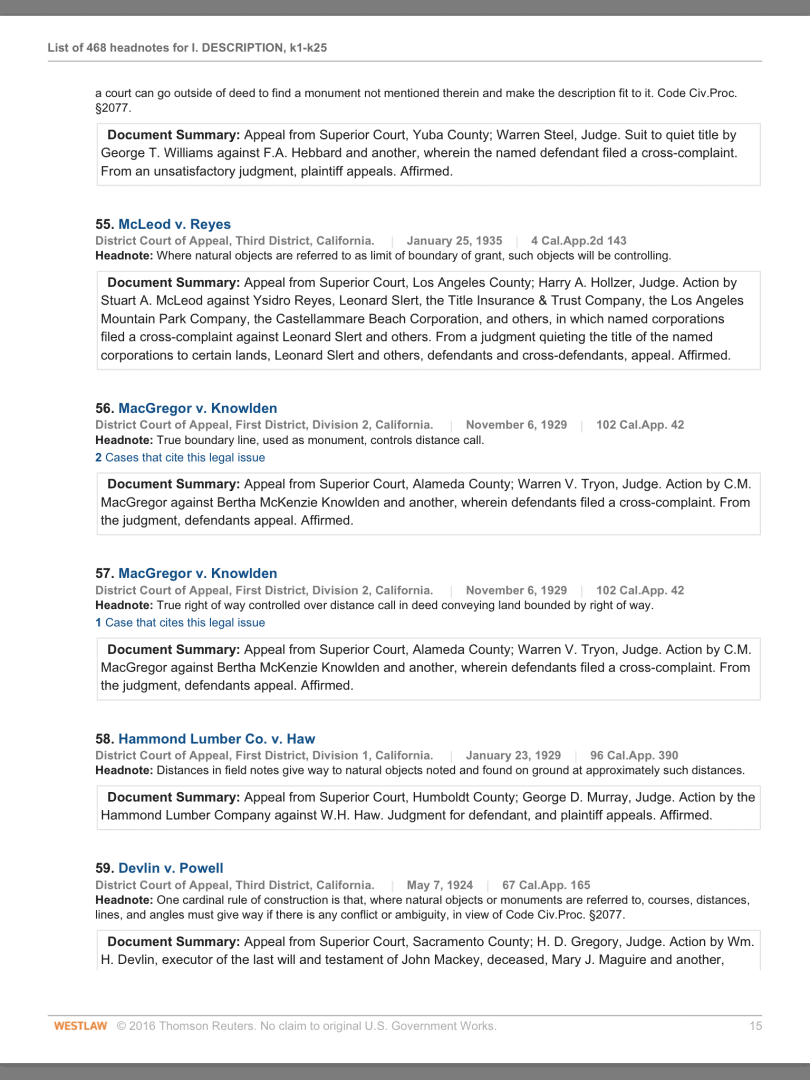
Here are a couple of pages from California:
Take note of 54. Reading the case, the "monument" was set by another potential buyer by pace. The claimant was not a party to the monument. If he had been then it would likely have been a proper case for our agreed boundaries doctrine. The western courts (or maybe PLSS states) seem to favor using establishment doctrines to get around monuments being uncalled for.
Posted : January 21, 2017 12:18 pm

Translate
▼
English
Spanish
French
German
Italian
Portuguese
Russian
Chinese
Japanese
Korean
Arabic
Hindi
Dutch
Polish
Turkish
Vietnamese
Thai
Swedish
Danish
Finnish
Norwegian
Czech
Hungarian
Romanian
Greek
Hebrew
Indonesian
Malay
Ukrainian
Bulgarian
Croatian
Slovak
Slovenian
Serbian
Lithuanian
Latvian
Estonian
Dave, thanks for posting this information. I will keep it for reference in the future. I have spent hours learning different aspects of surveying (public lands, geodesy, photogrammetry, writing and interpreting descriptions.....) but very little emphasis has been placed on researching case law and how to do the research which I now realize should have been a larger part of my training as a professional surveyor. Thanks again, Jon
Posted : January 22, 2017 12:21 pm