

Shawn Billings, post: 405157, member: 6521 wrote: Northeast Corner of A. T. McGee Survey, set by Arthur Stiles in 1934

One of the stump remains monumented by Stiles with an axle, 18" deep.
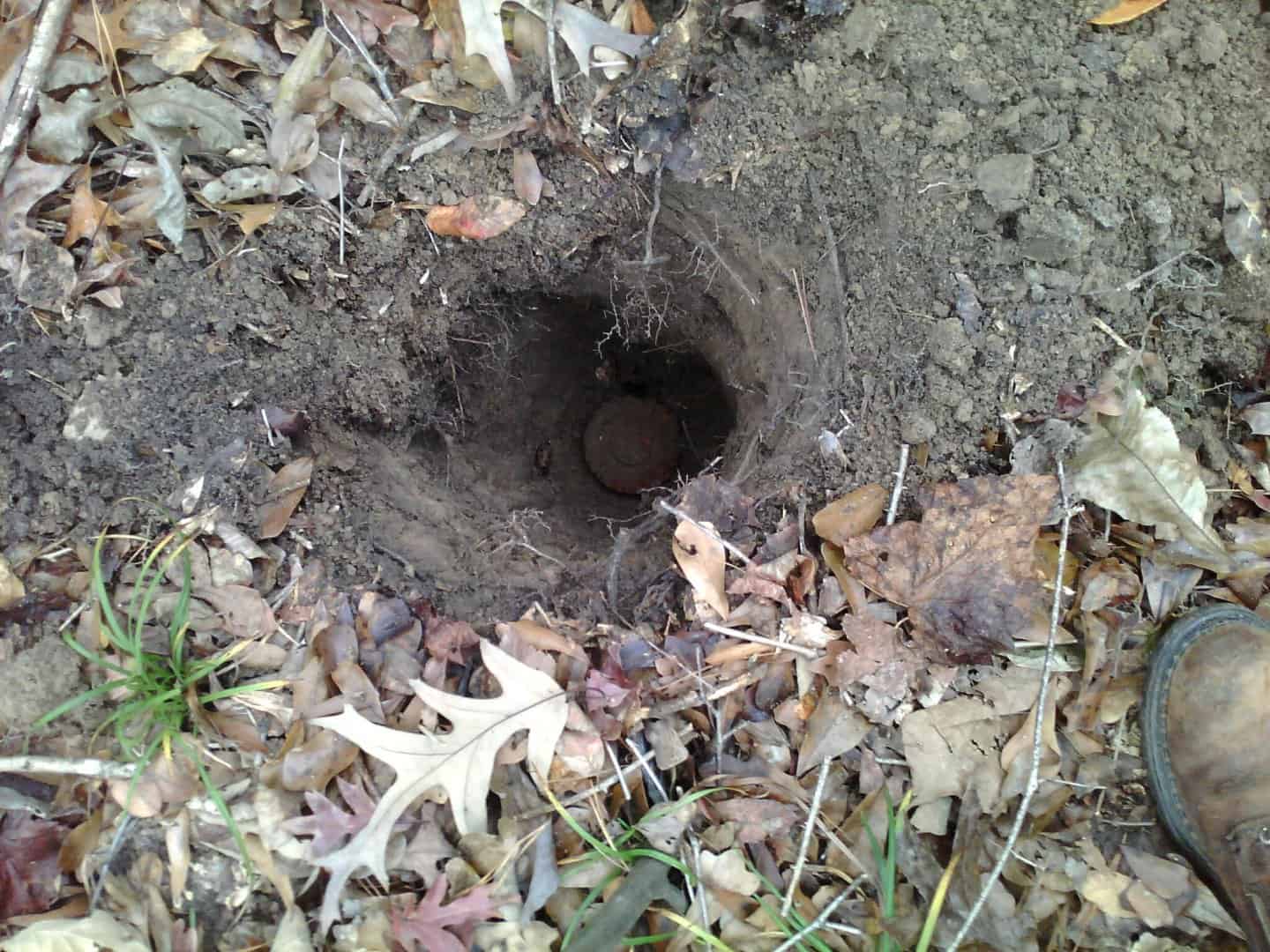
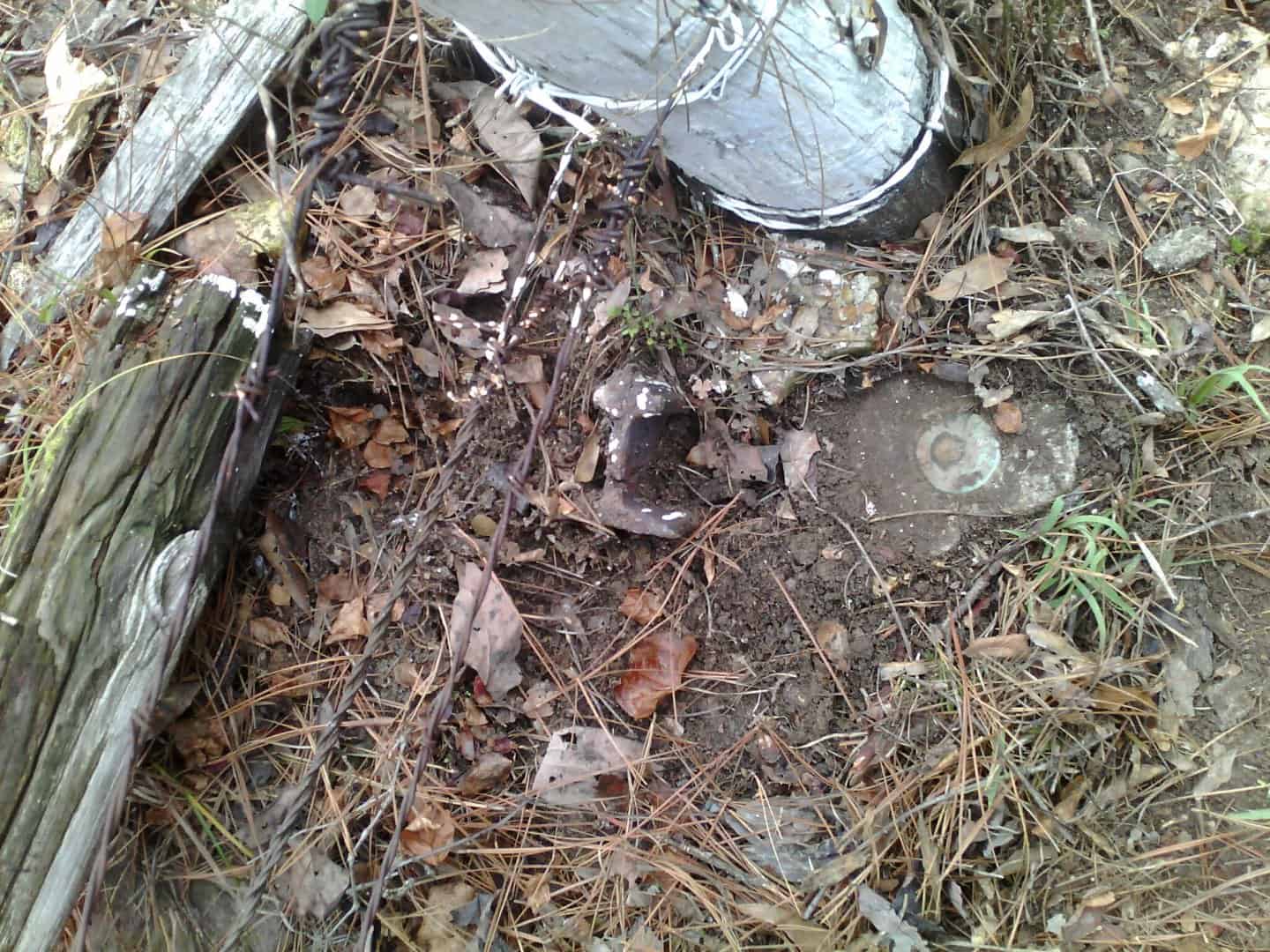
The Southeast Corner of the A. T. McGee Survey, recovered by Stiles in 1933, recognized by Elms in 1911 (crack visible). Also note city limits monument.
This is really special and a great job, it would have been great if you could had a few surveying students along to witness Boundary Retracement in the real world. Thanks for sharing.

One interesting thing about the survey that Thomas D. Brooks made in 1844 that Arthur Stiles was attempting to retrace ninety years later is that Deputy County Surveyor Brooks ran his survey at a variation of 9å¡20'E, The earlier survey of the Hayden H. Edwards Grant that Mr. Brooks called to adjoin was surveyed in 1835 using that same variation, 9å¡20'E. So, in ignorance of the change in magnetic declination, Mr. Brooks simply adjusted his compass for the same value and ran lines. This is very commonly encountered in retracing 19th-century surveys made in Texas, i.e. the same value of variation was adopted throughout a land disitict and used for years without note of the secular change.
The US Historical Declination models indicate that the value of 9å¡20'E probably was within a couple of minutes of correct in 1835, so things started well.
Kent McMillan, post: 405392, member: 3 wrote: One interesting thing about the survey that Thomas D. Brooks made in 1844 that Arthur Stiles was attempting to retrace ninety years later is that Deputy County Surveyor Brooks ran his survey at a variation of 9å¡20'E,
Minor correction: Mr. Brooks actually reported using a variation of 9å¡10' E in his locations of the McGee Survey in late 1844 and the Sarah Harrell Survey adjoining it to the North in early 1845. So the same variation used in the colonial period was not just blindly continued.

This was an ambitious project for me. I work alone and I wasn't sure if I would be up to the task. The property had a perimeter of over 15,000 feet, which I walked in its entirety at least once (some places more than once), and 2800 feet of that was along a meandering creek. The property is also dotted with active oil and gas wells and numerous pipelines, power lines and lease roads, which I located in my survey. My point file was in excess of 400 points, and the site is heavily wooded, mostly hardwoods. I haven't invested in a 4-wheeler yet. I'm loathe to take on debt, but it has been on my mind for a while and will likely be my next investment. As a result, this was all on foot. A 4-wheeler would not have helped with the boundary much, if at all, but would have saved a day in field, I'm estimating, in locating the topographic features.
I used RTK for the entire project. In some places I lost radio communications due to terrain and I used post processing, collecting short static files. In those instances, which were always under trees, I collected two static sessions so that I had some redundancy to compare the results. All produced repeatable results. I enjoy working alone. I like the freedom. I hated that it kept getting dark so early as I like working up to 7pm on field days when the light allows, but the season is a trade off - much less foliage with no snakes to deal with in exchange for shorter days. I'll take that trade most any day. I was the surveyor who signed the work and also dug the holes. This is a situation I really enjoy. But there are a couple of things I lament about solo. The first is that when I find an original Col. Arthur A. Stiles monument in the middle of the woods there is no one to celebrate the recovery with except for God, the trees and the squirrels. I did call a couple of people that understood the significance of the find and that helped, but it's not quite the same as sharing the experience with members of a survey crew who were there with you working toward the goal. The other drawback is the lack of mentoring. This would have been a great opportunity to share this experience with a surveying student as [USER=10727]@Bushwhacker[/USER] mentioned. Someday, I do hope to add a promising student to my one man show.
I know that I was much more efficient working alone with RTK than any two or three man crew running conventional would have been on this project. The technology also allowed me to tie in two remote monuments. This would not have been very practical conventionally, even if it would have been the technically correct thing to do. In that way, I think RTK allows a good surveyor to be even better, because he can tie in more evidence with less concern about cost overruns. The big thing RTK allows for is one-time pass-through. When we used to be conventional only, we'd often walk a property out with deed sketches in hand, looking for corners. We'd use a cloth tape or pacing to roughly get to the next search area and then begin a wide area search. Then we'd plan out our traverse to locate what we'd found. Then we'd run through the traverse. Then we'd evaluate the results and return to find anything we may have missed in our initial search. With RTK, I can typically perform the survey in a single circuit, and usually only a return to an area for any staking that might be required. I can navigate to approximate coordinates, find the monument, tie the monument and then proceed to the next monument, using the RTK to do the pacing and taping to get close and then using the RTK to tie the monument once recovered. If I see that it's only a few hundred feet to an adjoining corner, it's pretty easy to walk over, find the monument and tie it in too.
I couldn't have done this project without RTK.

slight hijack- if you can do it next week, buy that ATV. the dealers will blow them out the last week of the year.
i bought one a year ago this week. between the ATV and a trailer i spent about 9K (honda foreman, a polaris sportsman utility is a decent bit cheaper). it paid for itself, literally, in 2 jobs. of course they were both +/-30 acre topos, but i'm not exaggerating in any way when i say i took the money saved in labor on those jobs and paid off the honda.
and yeah, whenever i go back, i'm going back solo for real. after building (and selling) a successful business i've come to the conclusion i'd rather just go it alone.
Shawn Billings, post: 405408, member: 6521 wrote: I couldn't have done this project without RTK.
Isn't the main problem with that as a premise that you're already posted that:
"Stiles called for the line to be N 00å¡45'02" E, 2101.3 varas (which equals 5837 US Survey Feet).
I measured N 00å¡20'12" E (Geodetic) 5832.06 feet (Ground)."
In other words, you weren't exactly following a high-precision survey. When a WAAS-enabled handheld receiver will position at near that accuracy, it should be easily possible to navigate to the corners where, unless I'm sadly mistaken, a length of steel rail will not be a challenge to find. So, if finding the corners wasn't a challenge, why wouldn't a post-processed solution work perfectly well?
Probably the most interesting element of that resurvey to me is the open question as to whether Arthur Stiles was correct in some of his judgments. Stiles was not working in any official capacity and his work was apparently just filed for information since his corrected field notes don't appear in the patent file for the A.T. McGee Survey.
There were quite a few other corners and monuments required to complete the survey. Without a doubt a WAAS receiver and post processing would have sufficed to find and position these rails.
There were other surveys I was also retracing, one which had accurate state plane coordinates, one which used an astronomic bearing relation. This helped immensely in finding boundary monuments quickly.
Stiles report was compelling and in my opinion, the best evidence of the survey line.

I have a Polaris Sportsman 800, with welded rack, and plastic box on back.
If you go with 4 wheeler, get the 900, there is a VERY nice one, from the PoPo dealer, with pwr steering. I recommend that.
And, I have looked at the RANGERS, and the NEW Kawasaki MULE is huge, but very nice. It is a convertable... bed folds, and it seats 6.
It has 3 cylinder motor, pwr steering, and it is quite nice.
When you KNOW a job is well done, well, nothing quite like it!!
The NUMBER one good thing about the Javad setup is the CONFIDENCE. It's like KENT MCMILLAN in a box. You can quote me on that.
N
Nate The Surveyor, post: 405443, member: 291 wrote: I have a Polaris Sportsman 800, with welded rack, and plastic box on back.
If you go with 4 wheeler, get the 900, there is a VERY nice one, from the PoPo dealer, with pwr steering. I recommend that.
And, I have looked at the RANGERS, and the NEW Kawasaki MULE is huge, but very nice. It is a convertable... bed folds, and it seats 6.
It has 3 cylinder motor, pwr steering, and it is quite nice.
When you KNOW a job is well done, well, nothing quite like it!!The NUMBER one good thing about the Javad setup is the CONFIDENCE. It's like KENT MCMILLAN in a box. You can quote me on that.
N
I looked at rangers and mules, but came to the realization that (except for those mini-mules) they had essentially the same berth as the truck- seemed pointless to buy something that offered only a nominal advantage (turning radius) over just driving the truck through the woods.
And I bought a 500- hauling one person and maybe 50 pounds of gear, it does the job just fine. Running topo happens under 10mph, and I never had designs on racing it outside of work. I think that Polaris 450 (which Shawn can pick up in Longview for about 5K) would be perfectly adequate for a work vehicle. The wilds of NE Texas aren't the wilds of Or-Kansas.
Shawn Billings, post: 405434, member: 6521 wrote: Stiles report was compelling and in my opinion, the best evidence of the survey line.
Actually, Stiles report misstates the evidence that his map presents and would lead a surveyor to conclude that he had probably mislocated the Northwest corner of the McGee Survey. Note that he describes his location of the Northwest corner as agreeing "perfectly" with the old line of marked trees running South when the actual evidence he reported finding would place him about 12 varas West of the original line.
It does appear that he recovered the Northeast corner of the McGee Survey, even if he drifted into the realm of invention at the Northwest corner.
All a surveyor should have to do is to see how Stiles constructed the West line of the McGee Survey without bothering to locate the Northeast corner of the senior Haden H. Edwards Grant to suspect that Stiles wasn't up to the task.

flyin solo, post: 405445, member: 8089 wrote: I looked at rangers and mules, but came to the realization that (except for those mini-mules) they had essentially the same berth as the truck- seemed pointless to buy something that offered only a nominal advantage (turning radius) over just driving the truck through the woods.
And I bought a 500- hauling one person and maybe 50 pounds of gear, it does the job just fine. Running topo happens under 10mph, and I never had designs on racing it outside of work. I think that Polaris 450 (which Shawn can pick up in Longview for about 5K) would be perfectly adequate for a work vehicle. The wilds of NE Texas aren't the wilds of Or-Kansas.
I have surveyed out of both a 4-wheeler, and a Polaris Viking, the side by sides are the way to go, you get an area to hold your gear, three men can ride in it, you get a windshield for the tree limbs, I have taken the Viking in many areas I would not or could not drive a truck. The down side is you need a trailer, and a 4-wheeler can just be hauled in the bed of a truck.
I suggest Side by side. bench seat. NOT bucket. Hard to get in and out of, and tool belt won't fit well.
N
Kent McMillan, post: 405463, member: 3 wrote: Actually, Stiles report misstates the evidence that his map presents and would lead a surveyor to conclude that he had probably mislocated the Northwest corner of the McGee Survey. Note that he describes his location of the Northwest corner as agreeing "perfectly" with the old line of marked trees running South when the actual evidence he reported finding would place him about 12 varas West of the original line.
It does appear that he recovered the Northeast corner of the McGee Survey, even if he drifted into the realm of invention at the Northwest corner.
All a surveyor should have to do is to see how Stiles constructed the West line of the McGee Survey without bothering to locate the Northeast corner of the senior Haden H. Edwards Grant to suspect that Stiles wasn't up to the task.
I suspect that his primary purpose was determining if a vacancy actually existed. I suppose the Haden Edwards Survey line wasn't consequential to the answer. I wasn't concerned with the West line of the McGee survey so I didn't pay much attention to it.
Good thoughts about the true West line of the McGee survey. Likely more work would need to be done beyond Stiles report to establish it, but I think that you are expecting more from his survey than what he intended.
Shawn Billings, post: 405468, member: 6521 wrote: I suspect that his primary purpose was determining if a vacancy actually existed.
Yes, it was pretty clear from his report that he understood the central question to be the location of the East line of the McGee Survey, but it was wierd that he marked the Northwest corner of the McGee Survey in a position that wasn't really supported by the evidence and apparently just for the purpose of disagreeing with the corrected field notes that had been filed in the GLO in 1933 by W.H. McClelland.
I'll have to check Stiles's bio to see whethr he was still employed by the State as Reclamation Engineer in 1934 or whether this survey was Stiles's attempt to finding a new career as a boundary survey expert in retirement. His previous resume had mainly reflected topographic surveying and engineering work, I believe.
Yes, Arthur Alvord Stiles was born in Austin on August 28, 1871. So he was about 62 at the time of his work in Upshur County, possibly retired from the State Reclamation Department and looking for an engineering career that didn't deal with the design of ditches and levees.
There was a Stiles on the survey crew also.
Get a side by side if you're looking for a recommendation. We love ours. Polaris 400 is quite small and easily maneuverable. We have 300 hours on ours and no issues.
Shawn Billings, post: 405486, member: 6521 wrote: There was a Stiles on the survey crew also.
Yes, that would have been Aden Edmund Stiles, Arthur Alvord Stiles's son, born on October 5, 1906. He studied geology at UT and, according to the 1932 Cacus yearbook, was a member of Sigma Gamma Epsilon, an academic fraternity of geology students.
The younger Stiles died at age 61 in Austin, his occupation listed as "Retired Geologist" on his death certificate.
Here's his photo that appeared in the 1929 UT yearbook looking so clean cut that one would never suspect his association with geology.

Kris Morgan, post: 405488, member: 29 wrote: Get a side by side if you're looking for a recommendation. We love ours. Polaris 400 is quite small and easily maneuverable. We have 300 hours on ours and no issues.
I was leaning toward side by side. I don't want a crew cab. I don't want it really big either. I don't carry a lot as it is and if I keep it solo, I certainly don't need a lot of people space. But being able to carry and extra person comfortably would be nice. I also thought about one of those ACE ATV's from Polaris, but they don't have much bed space it seems. I was leaning toward a Polaris Ranger 570, but for starters I may just go with a 4-wheeler. I don't need one a lot right now, but it would have been nice on about half of my jobs the past six months.
The Charles Rado Ward, listed on Arthur A. Stiles's field notes as one of the chainmen, was born April 4, 1906 in Mexia, Texas and died on March 16, 1972 in Houston, his death certificate listing his occupation as "Petroleum Inspector".