

It's been a few years, but I now remember the ADA mine. A specimen from the ADA mine was displayed in the 1893 World Fair in Chicago. There was an ADA lode claim, as well as an ADA mill site. I think where we left off is that some boots on the ground were needed to search for evidence of the mill site. There were some likely areas shown on the geological map as well as 4 mine locations.
I don't think I knew where the mapping was in Denver, but thought that I might be able to find something on the internet.
Got busy and forgot about your project.

imaudigger, post: 455459, member: 7286 wrote: When talking OLD surveys, walking the line with a compass and hip chain is one of the best ways to follow in the footsteps of the original surveyor.
Taking the fastest and most direct path to the corner isn't always the best approach. I'm sure you know that.
Unfortunately my survey work includes very little old GLO corner searching where that method worked great. Looking for iron pins out in wheat fields it isn't very productive to walk the line. Most of the section corners I find now days are pipes in the middle of road intersections. You'd look pretty silly walking down the center of a road with your compass and hip chain. I personally never used a hip chain I paced everyone of them, but the Silva compass was a very important piece of equipment.
Those days are gone, it's LDPs, Site Calibrations, and State Plane Coordinates these days.

Skeeter1996, post: 455467, member: 9224 wrote: Unfortunately my survey work includes very little old GLO corner searching where that method worked great. Looking for iron pins out in wheat fields it isn't very productive to walk the line. Most of the section corners I find now days are pipes in the middle of road intersections. You'd look pretty silly walking down the center of a road with your compass and hip chain. I personally never used a hip chain I paced everyone of them, but the Silva compass was a very important piece of equipment.
Those days are gone, it's LDPs, Site Calibrations, and State Plane Coordinates these days.
I Hear ya Skeeter.
Most (probably 98+%) of my work IS 19th Century GLO Rectangular and/or Mineral Survey Retracement, so I see the world through a different pair of glasses.
To me, a "retracement" is defined as follows (1894 Manual, page 71)
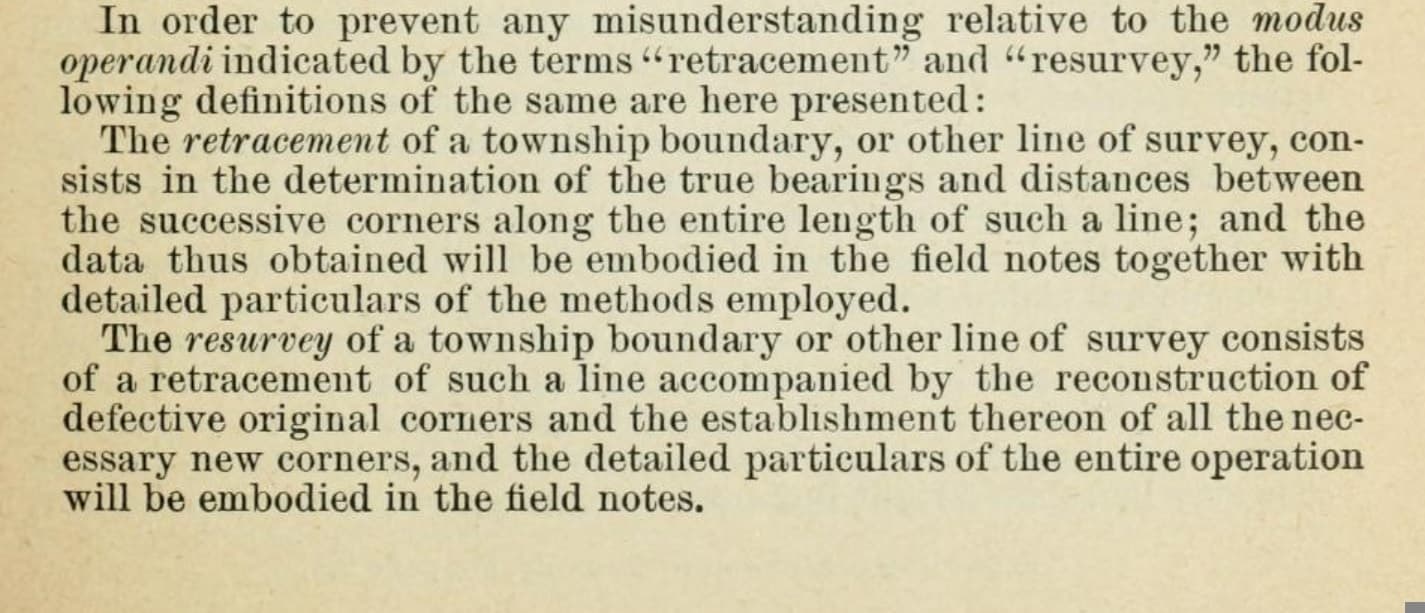
imaudigger, post: 455465, member: 7286 wrote: It's been a few years, but I now remember the ADA mine. A specimen from the ADA mine was displayed in the 1893 World Fair in Chicago. There was an ADA lode claim, as well as an ADA mill site. I think where we left off is that some boots on the ground were needed to search for evidence of the mill site. There were some likely areas shown on the geological map as well as 4 mine locations.
I don't think I knew where the mapping was in Denver, but thought that I might be able to find something on the internet.
Got busy and forgot about your project.
I remember that information. A big time Mineral Claim surveyor is the last one to do any field surveying. He pretty much used my guesses at the location of the claims. He "thinks" he found an additional to one of the claims. There was suppose to be a 1000 foot shaft into the mine. You would have thought that would generate alot of waste at the front of the additional. His adit didn't have any waste pile. They were using hand held GPS units so they really didn't generate much data to use. His adit needs to be checked out. The country was too steep for them, so they didn't spend much time looking for the corners.
There is a flat little meadow at the end of the draw. There's no evidence of a millsite being located there. It's kind of a steep pitch down to the creek. I would imagine a millsite needed alot of water. Those old miners had to be tough characters, so they could have packed water up that hill. I think I did see mention of the Ada millsite somewhere, but they never patented it. There are no records relating to it.
There was suppose to be a school house located at the fork of the two Creeks just below my guestimate of the claims site. There is no evidence of the school house left at all and it supposedly was used into the 1940s.I think the reference that mentioned the school house also mentioned the Ada Millsite.
The last clue I had was the drawer in Denver. Somebody in the Denver area was familiar with that drawer's location and was going to take a look to see what he could find, but he never got back to me.
I wouldn't let too many of these guys rile you up. Some people love to jump on a thread and assume the worse, which really isn't appropriate given they are usually dealing with a seasoned surveyor.
-------
As I mentioned a few years ago, I would love to visit this area and do some recon.
I routinely search for old mines in my neck of the woods.
Those old timers would build miles of wooden flume to pick up water from each of the small gullies and draws. Many times the lumber was salvaged, but more often it burned up in a wildfire. The only clue left is a scattered string of buried square nails sloughing down the hillsides and maybe some pieces of tin that were used to patch knotholes. As far as the lack of spoils or mill tailings...they make very good road base. If it was easily accessible they later used them on the wagon roads.
Around here, the county surveyor carried out many ditch surveys and tunnel surveys for the miners. I'm not sure if he did this in his official capacity.
imaudigger, post: 455480, member: 7286 wrote: I wouldn't let too many of these guys rile you up. Some people love to jump on a thread and assume the worse, which really isn't appropriate given they are usually dealing with a seasoned surveyor.
-------
As I mentioned a few years ago, I would love to visit this area and do some recon.
I routinely search for old mines in my neck of the woods.Those old timers would build miles of wooden flume to pick up water from each of the small gullies and draws. Many times the lumber was salvaged, but more often it burned up in a wildfire. The only clue left is a scattered string of buried square nails sloughing down the hillsides and maybe some pieces of tin that were used to patch knotholes. As far as the lack of spoils or mill tailings...they make very good road base. If it was easily accessible they later used them on the wagon roads.
Around here, the county surveyor carried out many ditch surveys and tunnel surveys for the miners. I'm not sure if he did this in his official capacity.
Well they wouldn't have hauled much of it away. There's no obvious evidence of a road or trails in the area. I've crawled all over both hillsides looking for the adit or discovery pits and never found anything. I should have found the possible adit the Professional found, but I don't remember seeing it.
I figured the scavengers had hauled off any wood that was left behind. The old school house remains have totally disappeared.
The County Surveyor surveyed the road up the drainage and it is a dedicated County Road. Another roadblock to records research is that the mine was originally located in a big County that was split up into several other Counties. We found the Road dedication in the wrong County's records.
There's probably a record somewhere that has a clue on it. You just have to get lucky and find it. All the Clerk and Recorder's people are younger and they don't know about the drawers and closets where things got filed. Not much help there in searching records anymore.
I've never found any old County Surveyor files in any of the Counties. I think they all took their records with them when they left office. The relatives probably pitched them in the burn barrel.

I was following a local description for a Moody Cotton Gin and there was one call that gave a distance and call for being so far from and parallel to the mill pond (which was a widened creek channel).
The only remaining evidence was the site of the water wheel channel and it was still there because it was where the creek channel narrowed and was lined with rock.
That did lead to finding most of the original monuments that led to the location of the parent tract monuments.
Then a second set of newer monuments were found about 1/2 chain south of all the original monuments.
The buyer was not happy that the mill property was not going to be his and he did not want it to be shown on the survey.
There was evidence in deed calls and on the ground that matched to an old road that went to and ended at the mill.
I doubt he ever went any farther to get title to that land because he thinks a fence will keep the real owners out.
Skeeter1996, post: 455509, member: 9224 wrote:
I could hook you up with the current owner and maybe you could work out a deal with him. He's had two different Surveyors in there plus the Professional and nobody has turned up a corner yet. You might get a paid vacation in the mountains of Montana. It use to be my Spring get in shape project for at least 5 years. My only failure.
Loyal, post: 454909, member: 228 wrote: I understand what you are doing, and if it works for you, then great.
I use a similar method, EXCEPT that I use an LDP to "mimic" the Record spatial paradigm (basis of bearing & ground distance). When everything is found, the Record v. Measured Bearings and shown, with NAD83(2011) Epoch 2010.0 Projection Parameters defining the Measured Bearings and Distances, and Latitudes Longitudes (or LDP Coordinates) tabulated for each Corner/Monument.
Loyal
Just watched a presentation over in GNSS. Come to find out I am also using a LDP it's just transparent to the user in Trimble.
What the heck are you and More using that you have to manually set one up?
I setup (compute) my LDP Parameters before ever hitting the ground. I know where I am going, the average "elevation" and extent of the project, and I can input all of the RECORD data (PLSS/MS/whatever) before I leave the office. By using aerial photography and USGS topographic maps, I can usually get the individual surveys into the database pretty close (close enough to find the FIRST Corner).
Obviously things change when I find the first CORNER, but that isn't really a problem, the LDP Parameters stay the same, each "survey" slides and/or rotates around to match the FOUND Corners. The Measured v. Record IS what it IS.
Loyal
Loyal, post: 455555, member: 228 wrote: I setup (compute) my LDP Parameters before ever hitting the ground. I know where I am going, the average "elevation" and extent of the project, and I can input all of the RECORD data (PLSS/MS/whatever) before I leave the office. By using aerial photography and USGS topographic maps, I can usually get the individual surveys into the database pretty close (close enough to find the FIRST Corner).
Obviously things change when I find the first CORNER, but that isn't really a problem, the LDP Parameters stay the same, each "survey" slides and/or rotates around to match the FOUND Corners. The Measured v. Record IS what it IS.
Loyal
Well I do exactly the same but I don't have to set up any LDP parameters the Trimble software in the Data Collector does it all for me.
So what process are you using to excuse the term "calibrate" your found position to your calculated position?
Skeeter1996, post: 455559, member: 9224 wrote: Well I do exactly the same but I don't have to set up any LDP parameters the Trimble software in the Data Collector does it all for me.
So what process are you using to excuse the term "calibrate" your found position to your calculated position?
I don't "calibrate" anything.
That's why there is a Record AND a Measured Bearing and distance shown on the plat, along with the NAD83 Projection Parameters that define the measured Bearings and distances.
See GLO definition of "retracement" that I posted.
😉
Loyal
Loyal, post: 455563, member: 228 wrote: I don't "calibrate" anything.
That's why there is a Record AND a Measured Bearing and distance shown on the plat, along with the NAD83 Projection Parameters that define the measured Bearings and distances.
See GLO definition of "retracement" that I posted.
😉
Loyal
Let me rephrase my question. How do you correlate the measured position you shot presumably with your GPS to the point you calculated. They can't be the same coordinate. There has to be some difference.
Skeeter1996, post: 455574, member: 9224 wrote: Let me rephrase my question. How do you correlate the measured position you shot presumably with your GPS to the point you calculated. They can't be the same coordinate. There has to be some difference.
I use AutoCAD as a graphic database of sorts. Each Survey (usually a Mineral Survey or a particular PLSS "line" [Section Corner to Section Corner]) exists as a BLOCK in the Project .dwg. When I find [say] Corner No.1 of MS-xxxx, I grab that BLOCK and move Corner-1 Theo. over to Corner 1 Found. This moves the entire Survey (w/ Bearing Trees, Objects, Rocks, Shafts, Adits, and terrain calls) over to MY reality. Once I find [say] Corner No.2 of said MS, I'll rotate the entire Block to fit that particular Bearing, and usually move "up to Corner No.2." I DON'T (usually) do any scaling of the Block, but there are exceptions. Once I have found all of the Corners, the BLOCK has served its purpose, and is frozen.
Loyal
Loyal, post: 455579, member: 228 wrote: I use AutoCAD as a graphic database of sorts. Each Survey (usually a Mineral Survey or a particular PLSS "line" [Section Corner to Section Corner]) exists as a BLOCK in the Project .dwg. When I find [say] Corner No.1 of MS-xxxx, I grab that BLOCK and move Corner-1 Theo. over to Corner 1 Found. This moves the entire Survey (w/ Bearing Trees, Objects, Rocks, Shafts, Adits, and terrain calls) over to MY reality. Once I find [say] Corner No.2 of said MS, I'll rotate the entire Block to fit that particular Bearing, and usually move "up to Corner No.2." I DON'T (usually) do any scaling of the Block, but there are exceptions. Once I have found all of the Corners, the BLOCK has served its purpose, and is frozen.
Loyal
Well my friend if you have a Trimble GPS system or Javad or any other reputable RTK system with a DC with basic routines in it. There is a routine in that software that does almost exactly what you are doing using a Helmert 7 point parameter transformation to determine the relationship between the two unrelated coordinate systems by comparing coordinate pairs from the two systems by Least Squares. You can do this as your standing on your found corner catching your breath to head for the next corner. Now I hope your sitting down. This is called Localization or Calibration.
You're basically doing the same thing manually. I would guess you're not packing a laptop up the hill so with your method you have to run back to town to translate your drawing to your field coordinate. Then you drive back to the job navigate to your next corner which you find a little left or right of the point you navigated to. You shoot that point and run back to town and rotate your drawing to match the second corner. I can't visualize any other way you could do it using your method.
If you use the Calibration routine in your DC it basically creates parameters that your DC uses to translate the Geographical coordinates your GPS unit has recorded to correlate them to your calculated coordinates. The DC doesn't change any of the geographical coordinates in you measured, but if you forget to hold the scale factor to 1.00 and the found corner has a big difference in it's location compared to your calculated position it applies a scale factor that screws up everything. I'm very cautious about using more that a 2 point calibration because if the calculated positions aren't correlating very good with the positions on the ground everything goes to hell and you get lost in the woods.
You mention AutoCAD. I would assume you mean either Land Development Desktop LDD or the devil's invention Civil3d. Your data collector will generate x, y, and z coordinates which if calibrated correctly will plot right on top of your drawing. It's so easy an Engineer can do it.
I got educated by Michael McInnis. He was an ornery old guy that traveled the Country making millions off of teaching calibration. They claim it doesn't rubber sheet after you calibrate using more than 4 points, but it does tilt the z axis and elevations on the edge of your project aren't very good.
I only use a 1 point calibration when I'm doing a topo survey. I always regarded NGS as good in the survey world, but they have some pretty bad benchmarks out there. I do OPUS on all my jobs requiring elevations because of the problems have had using NGS Benchmarks. Even NGS is begging surveyors to do OPUS observations on their benchmarks. Their Lat Long locations are garbage and the elevations in my opinion are suspect.
Skeeter1996, post: 455588, member: 9224 wrote: Well my friend if you have a Trimble GPS system or Javad or any other reputable RTK system with a DC with basic routines in it. There is a routine in that software that does almost exactly what you are doing using a Helmert 7 point parameter transformation to determine the relationship between the two unrelated coordinate systems by comparing coordinate pairs from the two systems by Least Squares. You can do this as your standing on your found corner catching your breath to head for the next corner. Now I hope your sitting down. This is called Localization or Calibration.
You're basically doing the same thing manually. I would guess you're not packing a laptop up the hill so with your method you have to run back to town to translate your drawing to your field coordinate. Then you drive back to the job navigate to your next corner which you find a little left or right of the point you navigated to. You shoot that point and run back to town and rotate your drawing to match the second corner. I can't visualize any other way you could do it using your method.
If you use the Calibration routine in your DC it basically creates parameters that your DC uses to translate the Geographical coordinates your GPS unit has recorded to correlate them to your calculated coordinates. The DC doesn't change any of the geographical coordinates in you measured, but if you forget to hold the scale factor to 1.00 and the found corner has a big difference in it's location compared to your calculated position it applies a scale factor that screws up everything. I'm very cautious about using more that a 2 point calibration because if the calculated positions aren't correlating very good with the positions on the ground everything goes to hell and you get lost in the woods.
You mention AutoCAD. I would assume you mean either Land Development Desktop LDD or the devil's invention Civil3d. Your data collector will generate x, y, and z coordinates which if calibrated correctly will plot right on top of your drawing. It's so easy an Engineer can do it.
I got educated by Michael McInnis. He was an ornery old guy that traveled the Country making millions off of teaching calibration. They claim it doesn't rubber sheet after you calibrate using more than 4 points, but it does tilt the z axis and elevations on the edge of your project aren't very good.
I only use a 1 point calibration when I'm doing a topo survey. I always regarded NGS as good in the survey world, but they have some pretty bad benchmarks out there. I do OPUS on all my jobs requiring elevations because of the problems have had using NGS Benchmarks. Even NGS is begging surveyors to do OPUS observations on their benchmarks. Their Lat Long locations are garbage and the elevations in my opinion are suspect.
I don't know what to tell ya buddy,
If you are "calibrating" to 19th Century GLO Record (or even Mineral Survey Record), then I guess my way wouldn't work for ya.
Loyal
Loyal, post: 455589, member: 228 wrote: I don't know what to tell ya buddy,
If you are "calibrating" to 19th Century GLO Record (or even Mineral Survey Record), then I guess my way wouldn't work for ya.
Loyal
I calibrate to every kind of survey. Most of the old GLO surveys are good to 20 or 30 feet. If I can get within 30 feet of a corner I'll find that baby or at least validate a fence corner.
You still haven't answered my question. How do you correlate your found corner coordinate to your calculated office coordinate. I'm like a dog with a bone. I won't let go.
Loyal, post: 455589, member: 228 wrote: I don't know what to tell ya buddy,
If you are "calibrating" to 19th Century GLO Record (or even Mineral Survey Record), then I guess my way wouldn't work for ya.
Loyal
Loyal I consider you a genius particularly in the OPUS arena. I feel you are holding something back.
Skeeter1996, post: 455590, member: 9224 wrote: I calibrate to every kind of survey. Most of the old GLO surveys are good to 20 or 30 feet. If I can get within 30 feet of a corner I'll find that baby or at least validate a fence corner.
You still haven't answered my question. How do you correlate your found corner coordinate to your calculated office coordinate. I'm like a dog with a bone. I won't let go.
Well I thought that I made that pretty clear.
The OFFICE (or Field Theo) coordinate is overridden by the FOUND Coordinate. Basically the Theo (Office) generated "block" MOVES to the FOUND Coordinate. This has the effect of updating all the other coordinates within that block/survey.
Inasmuch as Monuments Control over Bearing & Distance, the ??Record Bearing & Distance? only serves to help me Find the Monuments that Mark the Corners. Once I have Found the Corners, then I want to provide a trail of spatial breadcrumbs (footsteps) for the Next guy to follow. The formal projection parameters serves that purpose (inasmuch as everything is tied to the NSRS via the CORS). Because the LDP Parameters are on the my PLAT, anyone wishing to do so, can easily generate Lat/Lon, State Plane, or UTM Coordinates on any or all of said Corners, without having to reverse engineer anything.
Now there ARE cases where I might wish to generate ??PLSS DATUM True Bearings & Distances? between the several Corners, and the Lat/Lon/Eh on each Corner (monument) is all that I need to do that. I will admit at this point, that I don't [usually] return Ellipsoid Heights on all Plats (even though I probably should).
Loyal