

Mapman, post: 396314, member: 6096 wrote: With all of the "modern" earth moving equipment out there, it is incredibly easy to trench or shove earth in any direction. It may have been done years ago and that allowed for everything to settle back to "normal" with an undisturbed appearance.
We often assume the case that the monument was undisturbed. But in the same vein we can't say for sure it wasn't. All we have in the end is whether or not there is harmony with similar monuments. Any outliers need to be re-examined for evidence of possible disturbance.
The fact that the improvements were in harmony with the record lines indicates a possible disturbance of the monument. Finding evidence of that is now a matter of asking the owners of any knowledge of earth moving near the area. Utilities often run lines along fences and wall without regard to our monuments.
Evidence, evidence, evidence. Observe and record. It's our burden, our duty and I love it.
We had a case locally a few years back where a surveyor had tied a subdivision to a city control point. I can't remember how it came to light, but the monument had been ripped out and replaced by a utility contractor a year or so earlier. These monuments were cast in place concrete cylinders roughly 1 foot in diameter and several feet deep with 3 inch diameter aluminum disks on top and flush with or slightly below grade. I didn't see it personally, but was told that there were no visual indications that it had been removed and reset.

Stephen Ward, post: 396322, member: 1206 wrote: We had a case locally a few years back where a surveyor had tied a subdivision to a city control point. I can't remember how it came to light, but the monument had been ripped out and replaced by a utility contractor a year or so earlier. These monuments were cast in place concrete cylinders roughly 1 foot in diameter and several feet deep with 3 inch diameter aluminum disks on top and flush with or slightly below grade. I didn't see it personally, but was told that there were no visual indications that it had been removed and reset.
That's a good reason to have ties to two control monuments - as a check.

Rich,
Hold the record, show the monument as a witness corner. 😎

Kent McMillan, post: 396274, member: 3 wrote: If I'm understanding that, it suggests that the street lines were laid out first and the starred monument set in relation to a marker at the angle point in the street line on the same side of the street. In retracing and reconstructing old surveys, it's always a good idea to consider how the survey was actually made. In this case, I assume that would be by transit/tape methods, probably by running centerlines of the streets and turning angle bisectors at angle points in the centerlines to mark the angle points on opposite sides.
Here's another question that comes to mind: If the houses predate the plat of the subdivision, were some or all of the streets most likely laid out BEFORE the plat was prepared? Is there some separate record of the layout of the streets that would suggest that the subdivision layout was really made after the streets were in place and their lines marked?
Did they run centerlines on the East Coast? Or one of the sidelines then measure the full width to set the other side? I'm not sure.
Here at least from the 1940s they ran the centerlines in for construction staking then set the lot corners then after the streets were built they ran the final centerlines in, that is why there is often a systematic shift between the centerline pipes and the lot corners of up to 2 or 3 tenths even if they were being careful.
Rich., post: 396261, member: 10450 wrote: Yes could be. Although one thing I will say is when you parallel the street as located by the northerly monuments and they run right through both found on the southern side of the road, the angle point on the north side of Lot B (no monument found) would be just about the record distance from angle point to mysterious monument. Using the other side of the road parelled the shortage seems to occur between the North West corner of Lot B to the angle point.
If it was 1940 (just a random year I picked) and I was the local Surveyor tasked with setting Mr. Star monument I might set on the stone on north line of the street closest, sight east to the monument at the street corner, then measure the calculated distance along the R/W to a temporary point opposite the Star monument, then turn 90 and measure the street width across to set it. I wonder how those distances work or maybe i would've blundered on the distance calc?
I've noticed on old plats here from the 1920s when they first started building non perpendicular streets and curves they would still calc things like the whole subdivision is a perfectly square lot and block plat. For example, the half street width was 20' and the side street is at 80 degrees from the Main Street, they would still show the distance along the centerline as 20', not the longer distance it actually is.
Warren Smith, post: 396326, member: 9900 wrote: That's a good reason to have ties to two control monuments - as a check.
I learned that lesson early in my career, years before I was licensed. I was fresh out of school and had only been in the field for a few months. We were working on the surveying and engineering for raw cell tower sites. On of the requirements at that time was a "2C" letter that gave the position of the proposed tower to a tolerance of +-50' horizontal and +-20' vertical. We tried to use HARN points for control most of the time but around the edges of the state there just weren't enough of them. To keep our base lines short and reduce travel and occupation time we'd put our site coordinates into NGS and hope to find a point with good horizontal and vertical orders close to a road, park, or other location where we were reasonably sure we could run GPS. Of course, once we found a good point we'd use it for all of our work in that area. One such point was located just off a frontage road along the interstate with excellent access and sky view.
I was shown this point by a co-worker and used it repeatedly over several months without giving it much thought. A couple of years later with much more experience, I returned to use the point for a new project and made a horrible discovery. I realized that the center mark was an arrow rather than the dot inside a triangle that you typically see on horizontal & vertical control. I pulled the data sheet out of the folder, read closely and realized that I was on the azimuth mark. The point I'd thought I was on was about 25 feet further south along the frontage road and the same distance behind the sidewalk with a vertical difference of a couple of feet. Fortunately with the loose tolerances the previous work was still okay but it was a real eye opener for me on the need to double check everything. I learned a valuable lesson on the dangers of using a single control point or benchmark.

Paul in PA, post: 396319, member: 236 wrote: YES, buildings are pretty much immovable monuments. Have you considered that the star monument may have been intentionally set inside the Lot B line? I would then note it as off or as within Lot B.
It is definitely a Monument to the Corner, but that does not make the middle of it the corner.
Surveyors have to consider the preponderance of the evidence. I believe you have indicated enough evidence that it is not an original corner.
Paul in PA
No. I would have to assume they are not original corners. Old, yes. Very old, yes. Original, no.
StLSurveyor, post: 396316, member: 7070 wrote: I would knock on the door and ask Parcel B if they know where their NE corner was located? If he walks you to the big a** monument and says "Here!" I would accept it. Also, I would see if the bearing on the garage match the N/S line, to perhaps prove it was built with a the rear line of Parcel B in mind.
As another has said, "So to hold the monument would give the monument precedence as it is clearly visible and inmistakable as to what it represents" I think the jury would agree.
Why set another monument? The ones by the wall are off by 0.5' but you will accept them due to the division wall? I am sure Parcel A and B accept the monument as their corner and they both know it's there. Accepting it and moving on will probably not upset anyone. Just put a kink in the line, that's what they are living by?
This was my thought. The 2 triangle monuments on parcel A are different than any others. The third to the west that checks the 0.5 position resembles the rest. The 2 on the subject property though do not check the record distances even though the block monuments do. They also can be leaning somewhat, so that also must be taken into consideration tremendously.
Kent McMillan, post: 396269, member: 3 wrote: A couple of questions come to mind from looking at the photo above.
(1) Is the theory that the road was constructed after the stone marker was set and, if so, is the protrusion of the stone above grade consistent with that theory?
(2) Is the size and type of the stone identical to others more consistent with the pattern of the lot layout? Likewise any station mark in the top of the stone.
(3) Do all of the other stone markers protrude above grade by similar amounts?
My concern from afar is to wonder whether all of the stones are essentially identical in type, dimension and details of installation or whether there are features of the stone in the photo that are different from the rest of the group.
Great questions. The monuments in this area are a scattering of type. All stone. Some larger than others. some smaller. some stick up 6", some are flush, some are an inch below the current soil. Some lean, some dont. Some are greyish, some are blueish.
Here is some more fun stuff on the area....
This is actually framed hanging on my wall (funny where evidence can be)...

Interesting, this map is dated 1904. And as we can see, the houses already existed on parcel A & B. As did the roads.

Above is a pic of the 'Atlas' my grandfather had. We can see the monuments are are printed with the book. However not all were found when whoever made this book. (Or weren't there) but considering the NW corner of the block had a buried monument that fits the others, I'm assuming that was there, just not shown/found. Our star monument is not shown and that would be hard to miss.

Here is another block for comparison. It's hard to see but some corners have a penciled square that shows where a monument was found but not printed in the book.
Atlas was published 1905.
I'm going to dig far far back into the deeds of the properties and see what I find around the turn of the century

Have you checked to see whether Sanborn's Fire Insurance maps exist for that neighborhood at even earlier dates?

Hi Rich
I remember attending one of my first Westchester-Putnam meetings, probably early 1988. I was in your shoes, having recently received my NY License. Then WPAPLS President Jim Delano was on his soapbox, as was often the case, going on how we are to work to the standards of our area. NY is a huge state, with many different surveying styles. The LS from the Adirondacks may have a hard time in Westchester. I know I would have a hard time in Manhattan, the next county south. IÛªm sure you are aware of this. You have some good advice from surveyors here on Beer Leg, but it may, or may not agree with local customs. You work in an area where the record map is almost sacred. Most of the errors have been found and resolved by now. But, as in all survey matters, that is not a rule; it depends.
I posted this story a while ago, but it may apply to your situation, or it may not. I started surveying in the NE corner of Bergen County, NJ, where, like Westchester, a ÛÏmonumentÛ is a stone or concrete post, generally 4 or 5 inches square at the top, with a cross cut, drill hole or metal plug to mark the exact location. Monuments were generally set by the subdividing surveyor, or sometimes for a client with deep pockets who just wanted ÛÏpermanentÛ property markers. Pipes, pins, nails, cut crosses and drill holes were often seen as inferior to a monument. It was just regional practice.
It is the early 80s. I now have a NJ license. Doing a side job, I bring my younger brother along to help me with the fieldwork. We are taping down the rear line and I come across an old bluestone monument, the type set by the old surveyor who did the subdivision we are in. I get excited. My brother asks what it the big deal for finding that. I explain how they are reasonably permanent and are set to control where property lines are. He gets a sheepish look on his face. I ask whatÛªs up? Well, he worked for a fence company. They start at a corner and proceed down the line, digging holes for every pre-built fence panel. When they get to the corner, if it was a little tight to a found survey marker, and it is easy digging (much of NE Bergen County is coarse red sand, real easy digging) they just dig next to the monument, shove it over with the bar and put in a full fence panel. Much quicker and easier than cutting a panel down to fit.
Then there was a survey I did on a busy road down in New Rochelle. Subdivision plat shows offset monuments across the frontage. Find monuments in the sidewalk. They did not check too well. Somehow I wound up talking with the Con-Ed ÛÏsurveyorsÛ (field guys, not licensed) probably when I went to get the utility plates, only to find out they had dug them out for an installation, but realizing they were important, they saved them so they could ÛÏput them back.Û Sort of.
Monuments move. Sometimes.
Then there is the situation where the monuments control, but may not be on the corner. Look at Westchester County Clerk Map 4171. For those reading this that do not have access to the Westchester County ClerkÛªs on-line maps. Back in 1935 the main survey firms of Westchester County (Ward Carpenter, Dearing, Farley, Sells, and Bodner) all agreed to hold the monuments (stone and concrete posts, see above) set as part of a large, curvilinear road system in accordance with the offsets from the monuments to the map corners, preserving the map geometry by referencing the sometimes poorly set monuments. Harmony among survey firms, all is good. Local practice.
You are in an area where old record surveys, even if private and not ÛÏpublicÛ information, hold a lot of importance. You have buildings and improvements that agree with the record shapes. Do you really throw all that out to hold a monument of unknown province? Maybe. maybe not.
Good luck.
Ken
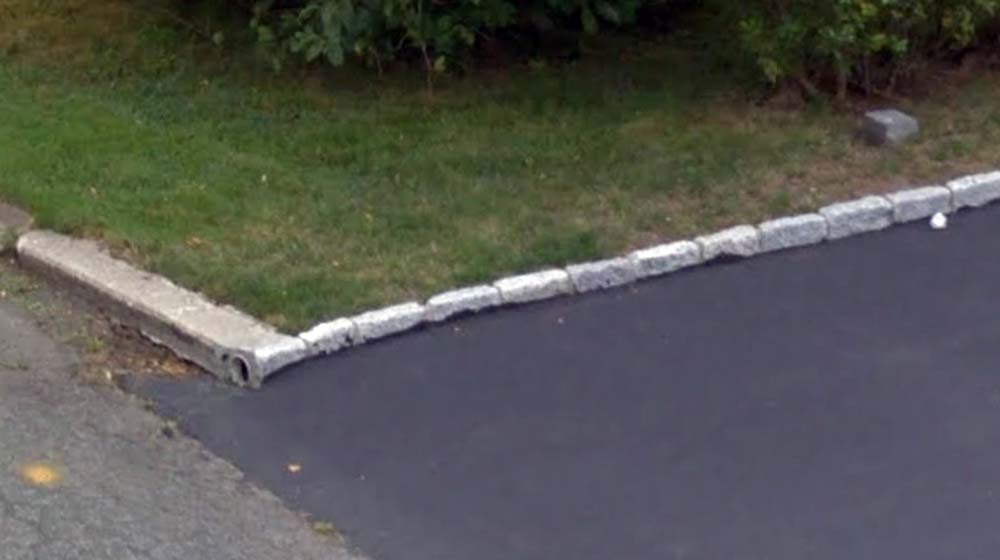
In light of Ken's comments above, the Street View shows what appears to be a drain line running between the driveway curbing and the stone marker. Is that construction the possible cause of disturbance of the stone?
Ken Salzmann, post: 396361, member: 398 wrote: Hi Rich
I remember attending one of my first Westchester-Putnam meetings, probably early 1988. I was in your shoes, having recently received my NY License. Then WPAPLS President Jim Delano was on his soapbox, as was often the case, going on how we are to work to the standards of our area. NY is a huge state, with many different surveying styles. The LS from the Adirondacks may have a hard time in Westchester. I know I would have a hard time in Manhattan, the next county south. IÛªm sure you are aware of this. You have some good advice from surveyors here on Beer Leg, but it may, or may not agree with local customs. You work in an area where the record map is almost sacred. Most of the errors have been found and resolved by now. But, as in all survey matters, that is not a rule; it depends.
I posted this story a while ago, but it may apply to your situation, or it may not. I started surveying in the NE corner of Bergen County, NJ, where, like Westchester, a ÛÏmonumentÛ is a stone or concrete post, generally 4 or 5 inches square at the top, with a cross cut, drill hole or metal plug to mark the exact location. Monuments were generally set by the subdividing surveyor, or sometimes for a client with deep pockets who just wanted ÛÏpermanentÛ property markers. Pipes, pins, nails, cut crosses and drill holes were often seen as inferior to a monument. It was just regional practice.
It is the early 80s. I now have a NJ license. Doing a side job, I bring my younger brother along to help me with the fieldwork. We are taping down the rear line and I come across an old bluestone monument, the type set by the old surveyor who did the subdivision we are in. I get excited. My brother asks what it the big deal for finding that. I explain how they are reasonably permanent and are set to control where property lines are. He gets a sheepish look on his face. I ask whatÛªs up? Well, he worked for a fence company. They start at a corner and proceed down the line, digging holes for every pre-built fence panel. When they get to the corner, if it was a little tight to a found survey marker, and it is easy digging (much of NE Bergen County is coarse red sand, real easy digging) they just dig next to the monument, shove it over with the bar and put in a full fence panel. Much quicker and easier than cutting a panel down to fit.
Then there was a survey I did on a busy road down in New Rochelle. Subdivision plat shows offset monuments across the frontage. Find monuments in the sidewalk. They did not check too well. Somehow I wound up talking with the Con-Ed ÛÏsurveyorsÛ (field guys, not licensed) probably when I went to get the utility plates, only to find out they had dug them out for an installation, but realizing they were important, they saved them so they could ÛÏput them back.Û Sort of.
Monuments move. Sometimes.
Then there is the situation where the monuments control, but may not be on the corner. Look at Westchester County Clerk Map 4171. For those reading this that do not have access to the Westchester County ClerkÛªs on-line maps. Back in 1935 the main survey firms of Westchester County (Ward Carpenter, Dearing, Farley, Sells, and Bodner) all agreed to hold the monuments (stone and concrete posts, see above) set as part of a large, curvilinear road system in accordance with the offsets from the monuments to the map corners, preserving the map geometry by referencing the sometimes poorly set monuments. Harmony among survey firms, all is good. Local practice.
You are in an area where old record surveys, even if private and not ÛÏpublicÛ information, hold a lot of importance. You have buildings and improvements that agree with the record shapes. Do you really throw all that out to hold a monument of unknown province? Maybe. maybe not.
Good luck.
Ken
Thanks Ken.
Great advice. Actually just the insight I was looking for.
As stated in my original post, the deeds all seem to stem from lots that were individually measured. Since they all agree to such a small degree it seems highly unlikely this monument is 'correct' as it was quite clearly not in existence when the measurements of the existing lots were taken. And also like you said it seems the record, old surveys, and buildings all relied on the record shapes which work great (in terms of equity) it seems more reasonable that they should be held.
Kent McMillan, post: 396362, member: 3 wrote: In light of Ken's comments above, the Street View shows what appears to be a drain line running between the driveway curbing and the stone marker. Is that construction the possible cause of disturbance of the stone?
Very possible. Wow. You are observant.
Just out of curiosity, I took a quick google. I take it that the block you're working in is shown on Map 610 and is bounded by streets that were laid out in the 1870s as shown on Map 610? Are the lots that you're dealing with best described as the result of a resubdivision of some lots or block shown on Map 610?

Stephen Ward, post: 396338, member: 1206 wrote: I was on the azimuth mark. The point I'd thought I was on was about 25 feet further south
To be pedantic, I'm pretty sure you were on a reference mark, not the azimuth mark, at a distance of 25 ft. A C&GS/NGS azimuth mark was rarely less than a quarter mile from the triangulation station, whereas the RMs were usually within one tape lengh. The RMs were there to help find the triangulation station, which was often buried.
Bill93, post: 396807, member: 87 wrote: To be pedantic, I'm pretty sure you were on a reference mark, not the azimuth mark, at a distance of 25 ft. A C&GS/NGS azimuth mark was rarely less than a quarter mile from the triangulation station, whereas the RMs were usually within one tape lengh. The RMs were there to help find the triangulation station, which was often buried.
I'd have to go back and pull the data sheets to be sure. That's what I get for telling stories from memory. 🙂

could mark the road right of way but not a lot corner.... I like D Karoly's comment and Kent Mc has retraced a lot of old town tracts and while his comments may not be apt for the laws of your state, his comments on evaluation of evidence are extremely useful.

Paul in PA, post: 396319, member: 236 wrote: YES, buildings are pretty much immovable monuments. Have you considered that the star monument may have been intentionally set inside the Lot B line? I would then note it as off or as within Lot B.
It is definitely a Monument to the Corner, but that does not make the middle of it the corner.
Surveyors have to consider the preponderance of the evidence. I believe you have indicated enough evidence that it is not an original corner.
Paul in PA
careful.....you're advocating the dreaded virtual pin cushion from the other thread. (I think you're right)

I just "re-read" Cooley and have even more confidence in holding monuments until proven to be a) not original, b) moved, such an obvious blunder that they MUST be rejected.